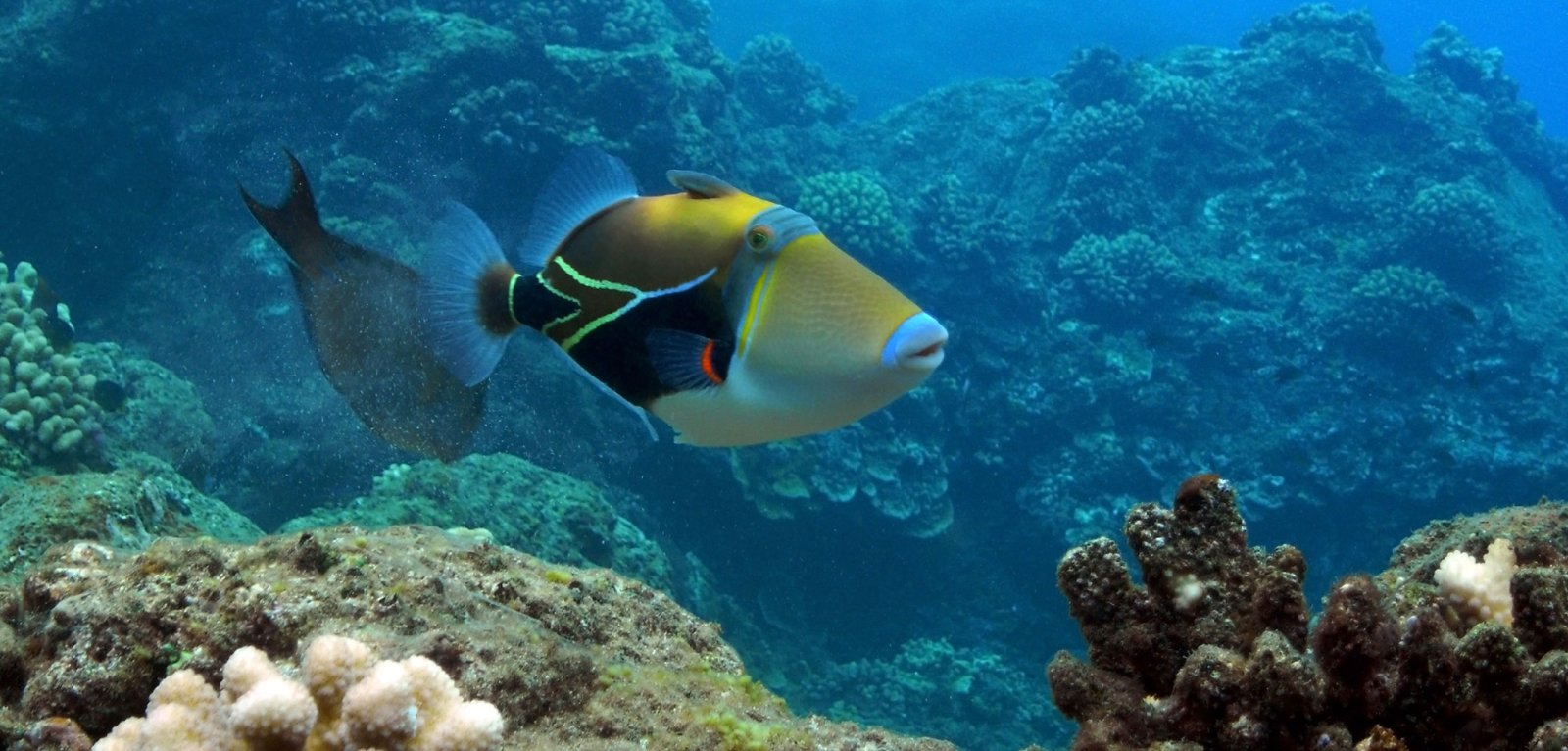

Hawaii's State Fish: The Humuhumunukunukuapua'a
The humuhumunukunukuapua'a (Rhinecanthus rectangulus) is the official state fish of Hawaii. If you have been trying to pronounce that name since you first saw it on a souvenir shop t-shirt, you are not alone. It is one of the longest words in the Hawaiian language and one of the most fun to say once you get it down.
This reef triggerfish earned its state title in 1985, but the designation was temporary. It expired in 1990 and the fish swam in bureaucratic limbo for 16 years. In 2006, the Hawaii state legislature made it permanent. The humuhumu has held the title ever since.
The name breaks down into pieces. "Humuhumu" means triggerfish. "Nukunuku" means snout. "A" means like. "Pua'a" means pig. Put it together: triggerfish with a snout like a pig. Look at one underwater and the name makes perfect sense. That angular face tapers into a small, pig-like mouth.
Adults measure 6 to 10 inches long. The body is angular and wedge-shaped, covered in distinct color bands of tan, brown, yellow, and blue. A bright yellow stripe runs behind the eye. Blue and black lines streak across the face. They are territorial and surprisingly aggressive for their size. Divers sometimes watch them chase fish twice as large off their patch of reef.
You will find them at virtually every snorkeling spot in Hawaii. They prefer shallow reef flats and lagoons, usually in water less than 15 feet deep. They are not shy. Swim slowly over a reef and you will likely spot one within minutes.
How to Pronounce Humuhumunukunukuapua'a
The trick is breaking it into small chunks. Do not try to say the whole thing at once.
HOO-moo-HOO-moo-NOO-koo-NOO-koo-AH-poo-AH-ah
Segment by segment:
- Humu (HOO-moo) - triggerfish
- humu (HOO-moo) - repeated for emphasis
- nuku (NOO-koo) - snout
- nuku (NOO-koo) - repeated
- a (AH) - like
- pua'a (poo-AH-ah) - pig (the okina between the two a's creates a glottal stop)
Say it three times fast and you will have it. Most locals just say "humuhumu" (HOO-moo-HOO-moo) and everyone knows what they mean.
The name gained mainstream fame through the 1933 song "My Little Grass Shack in Kealakekua, Hawaii," which includes the lyric "where the humuhumunukunukuapua'a goes swimming by." The song remains a standard at luaus across the islands.
Common Hawaiian Reef Fish
Hawaii's reefs host over 500 species of fish, about 25% of which are found nowhere else on Earth. These are the ones you will see most often while snorkeling. Learning even a few Hawaiian names adds a layer of connection to the experience.
Humuhumunukunukuapua'a (Reef Triggerfish)
The state fish. Angular body with tan, yellow, blue, and black markings. Common on shallow reefs across all islands. Territorial and unafraid of snorkelers. You will likely spot one within your first ten minutes in the water.
Lau'ipala (Yellow Tang)
Bright, solid yellow and impossible to miss. The most recognizable reef fish in Hawaii. They travel in small schools and graze on algae growing on rocks and coral. Abundant at nearly every snorkeling location, especially along the Kona coast of the Big Island.
Kikakapu (Raccoon Butterflyfish)
Yellow body with a black mask across the eyes, giving it the raccoon name. Usually seen in pairs. They mate for life and patrol the same section of reef together. One of the easier butterflyfish to identify because of that distinctive face mask.
Manini (Convict Tang)
White body with vertical black stripes, like a cartoon jailbird. Travels in large schools that sweep across the reef eating algae. Among the most common fish in Hawaii. If you see a cloud of striped fish, those are manini.
Uhu (Parrotfish)
Large, colorful, with a beak-like mouth made of fused teeth. Parrotfish bite chunks of coral to eat the algae inside, then excrete the calcium carbonate as fine white sand. That white sand on your favorite beach? Parrotfish made much of it. You can hear them crunching coral underwater from 20 feet away.
Hinalea (Saddle Wrasse)
The most common reef fish in Hawaii. Green and orange body with a distinctive light saddle mark behind the head. Endemic to Hawaii, meaning you will not find them anywhere else. Active swimmers that dart around the reef all day.
Puhi (Moray Eel)
Spotted or mottled skin, lives in reef crevices and holes. They look menacing with their constantly opening and closing mouths, but that motion is just breathing. They are not aggressive unless provoked. The rule: do not stick your hands into reef holes. Ever.
Kumu (Whitesaddle Goatfish)
Red or pink body with a white saddle marking. Bottom feeders that use two chin barbels (whisker-like appendages) to probe the sand for food. Considered sacred in Hawaiian culture. Kumu were reserved for offerings and chiefly feasts in old Hawaii.
La'o (Needlefish)
Long, thin, and silver with a pointed snout. Swims just below the surface, often in small groups. They can startle snorkelers because they move fast, but they are harmless. You will see them in shallow, calm bays.
Honu (Green Sea Turtle)
Not a fish, but the encounter every snorkeler hopes for. Hawaiian green sea turtles are a protected species under both federal and state law. They are common at many snorkeling spots, often grazing on algae on rocks or resting on sandy bottoms. Maintain at least a 10-foot distance. Do not touch them, chase them, or block their path. Fines start at $500 and go much higher.
Nunu (Trumpetfish)
Long and slender, up to three feet, with a tubular snout. Masters of camouflage. They often hover vertically alongside coral branches or sea rods, hiding in plain sight. You might swim right past one before your brain registers what you are looking at. They come in brown, green, and yellow varieties.
Kihikihi (Moorish Idol)
The most dramatic-looking fish on Hawaiian reefs. Bold black, white, and yellow vertical bands with a long, trailing dorsal fin that streams behind like a pennant. If you watched Finding Nemo, this is Gill. Usually seen alone or in pairs along reef walls and drop-offs.
Best Places to See Reef Fish in Hawaii
Every Hawaiian island has world-class snorkeling. The fish do not care which island you are visiting. Here are the top spots, organized by island.
Oahu
Hanauma Bay is the most famous snorkeling destination in Hawaii for good reason. This protected marine preserve inside a volcanic crater hosts over 400 species of fish. Shark's Cove on the North Shore is the expert-level alternative, with deeper water and lava tube caverns. Both locations require calm conditions. Check the ocean report before heading out.
Maui
Molokini Crater is a partially submerged volcanic crater about three miles offshore. Visibility regularly exceeds 150 feet. You will need a boat tour to get there. Honolua Bay on West Maui is the best shore-entry option, with a protected marine reserve that teems with fish.
Big Island
Kahalu'u Beach Park in Kailua-Kona is beginner-friendly with a shallow, protected reef. Kealakekua Bay (Captain Cook) is widely considered the best snorkeling in the state. Crystal-clear water, spinner dolphins, and dense schools of reef fish in a marine life conservation district.
Kauai
Poipu Beach on the south shore is reliable year-round. Tunnels Beach (Makua) on the north shore has some of the most spectacular reef formations in Hawaii, but it is only accessible during calm summer months.
For a complete island-by-island breakdown, see our snorkeling guides:
- Best Snorkeling on Oahu
- Best Snorkeling in Maui
- Best Snorkeling on the Big Island
- Best Snorkeling on Kauai
If you want a guide to point out species as you swim, a guided snorkel tour is the fastest way to learn. Browse snorkel tours on Viator for options across all four islands, from Molokini boat trips to Kealakekua Bay kayak-and-snorkel combos.
Protecting Hawaii's Reef Fish
Hawaii's coral reefs are under pressure from warming oceans, coastal development, and millions of annual visitors. Every snorkeler plays a role in keeping these reefs alive.
Since January 2021, Hawaii has banned the sale of sunscreens containing oxybenzone and octinoxate, two chemicals shown to damage coral. Use reef-safe sunscreen with zinc oxide or titanium dioxide as the active ingredient. Better yet, wear a rash guard and skip the sunscreen on your torso entirely.
A few rules that protect the reef and the fish living on it:
- Do not touch or stand on coral. A single footstep can crush decades of growth.
- Do not feed the fish. It disrupts their natural behavior and diet.
- Keep at least 10 feet from honu (sea turtles) and monk seals. Both are federally protected.
- Enter and exit the water carefully. Shuffling across a reef flat causes more damage than most people realize.
- Take nothing. Shells, coral, sand, and lava rocks stay in Hawaii.
These reefs took thousands of years to build. The fish depend on them. So does every snorkeler who comes after you.
Frequently Asked Questions
What is the Hawaii state fish?
The Hawaii state fish is the humuhumunukunukuapua'a (reef triggerfish, Rhinecanthus rectangulus). It was designated the official state fish in 2006 after first being named in 1985 on a temporary basis.
How do you pronounce humuhumunukunukuapua'a?
Break it into segments: HOO-moo-HOO-moo-NOO-koo-NOO-koo-AH-poo-AH-ah. It translates to triggerfish with a snout like a pig. Most locals just call it the humuhumu.
Where can you see the humuhumunukunukuapua'a?
You can spot them at most snorkeling locations across all Hawaiian islands. They are common in shallow reef areas. Top spots include Hanauma Bay on Oahu, Molokini Crater off Maui, Kahalu'u Beach on the Big Island, and Poipu Beach on Kauai.
Are Hawaiian reef fish dangerous?
Most Hawaiian reef fish are harmless to snorkelers. Avoid touching moray eels or stepping on sea urchins. The biggest risk is sunburn, not fish. Wear reef-safe sunscreen and a rash guard for protection.