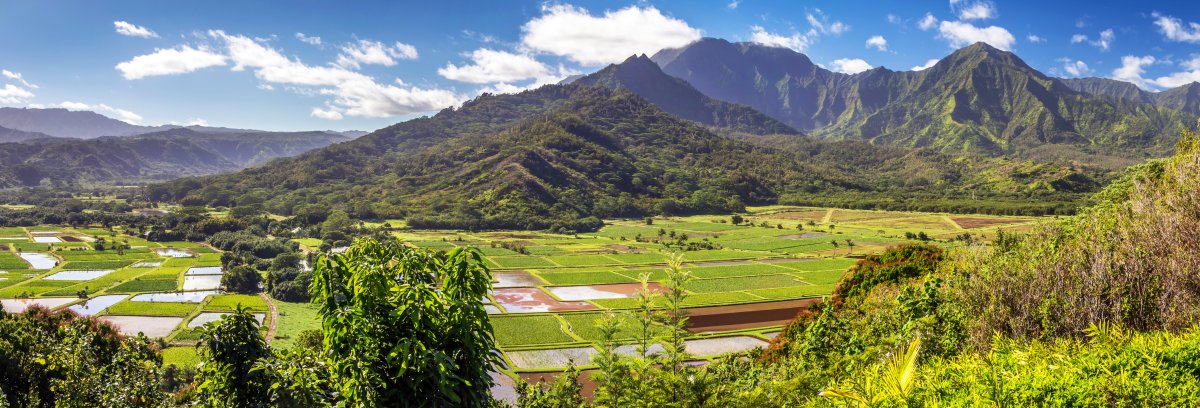

Most of Hawaii’s best views face the ocean. Hanalei Valley is the exception.
This inland panorama on Kauai’s north shore is one of the finest in the state. The valley floor is a patchwork of taro fields and wetlands. Behind it, jagged green mountains rise into clouds, laced with waterfalls and prone to sudden rainbows. It looks like someone invented the concept of “lush” specifically to describe this place.
The Hanalei National Wildlife Refuge sits in the middle of it all. Established in 1972, it is Kauai’s oldest wildlife refuge. The 917-acre wetland habitat protects several endangered species, including the Hawaiian stilt (ae’o), Hawaiian coot (‘alae ke’oke’o), Hawaiian moorhen (‘alae ‘ula), and Hawaiian duck (koloa maoli). The refuge itself is closed to the public. Always has been.
But the view into it is open to everyone. And that view tells a story that goes back centuries. Hanalei Valley contains roughly 60% of Hawaii’s taro production. Taro — kalo in Hawaiian — is not just a crop here. It is the elder sibling of the Hawaiian people in the Kumulipo, the Hawaiian creation chant. The plant that feeds the nation. The fields you see from above are a living agricultural tradition that predates Western contact by hundreds of years, and they are still cultivated by local families today.
Birding is the other draw. Even from the overlook, you can spot endangered waterbirds wading through the flooded lo’i (taro paddies). Bring binoculars. The stilts are easy to pick out — long pink legs, black and white bodies. The coots and moorhens are harder to distinguish at distance, but they are down there. The U.S. Fish and Wildlife Service manages the refuge specifically for these species, and population counts have improved since the refuge was established.