
Hawaiʻi has a reputation as a place to relax. Hammock, mai tai, sunset, repeat. And sure, you can do that. But the islands also sit on top of some of the most dramatic terrain on Earth — volcanic ridges, 3,000-foot sea cliffs, open ocean, and rainforest canopy that drops into valleys so steep they have never been developed. That terrain creates adventure opportunities you cannot replicate anywhere else.
This is a ranked list of the best high-adrenaline activities across all four major islands. The ranking weighs three things: the quality of the experience itself, the uniqueness of the Hawaiian setting, and whether the price justifies what you get. Every operator listed is established, licensed, and has a strong safety record.
1. Skydiving Over Oahu's North Shore
Nothing else on this list matches the raw intensity of stepping out of a plane at 14,000 feet above the North Shore. Pacific Skydiving Center operates from Dillingham Airfield at the western end of the North Shore — a small general aviation strip wedged between the Waianae Mountains and the ocean.
The tandem jump takes about 7 minutes total: a 60-second freefall at 120 mph, then a 5-6 minute canopy ride. During freefall you can see the Waianae Range, the turquoise reef shelf, and the surf breaks of Pipeline and Sunset Beach laid out below you like a map. On clear days, you can spot Kauai and Molokai on the horizon.
Cost: $280-$350 for the tandem jump. Video and photo packages run an additional $100-$150. You need the video. You will not remember what your face was doing at 120 mph. You can check availability and book a tandem jump on Viator.
Why it ranks #1: No other adventure activity in Hawaiʻi combines this level of adrenaline with this caliber of scenery. The North Shore drop zone is consistently rated one of the most scenic in the world. One jump and the rest of your vacation feels calm by comparison.
2. Helicopter Tour of the Na Pali Coast
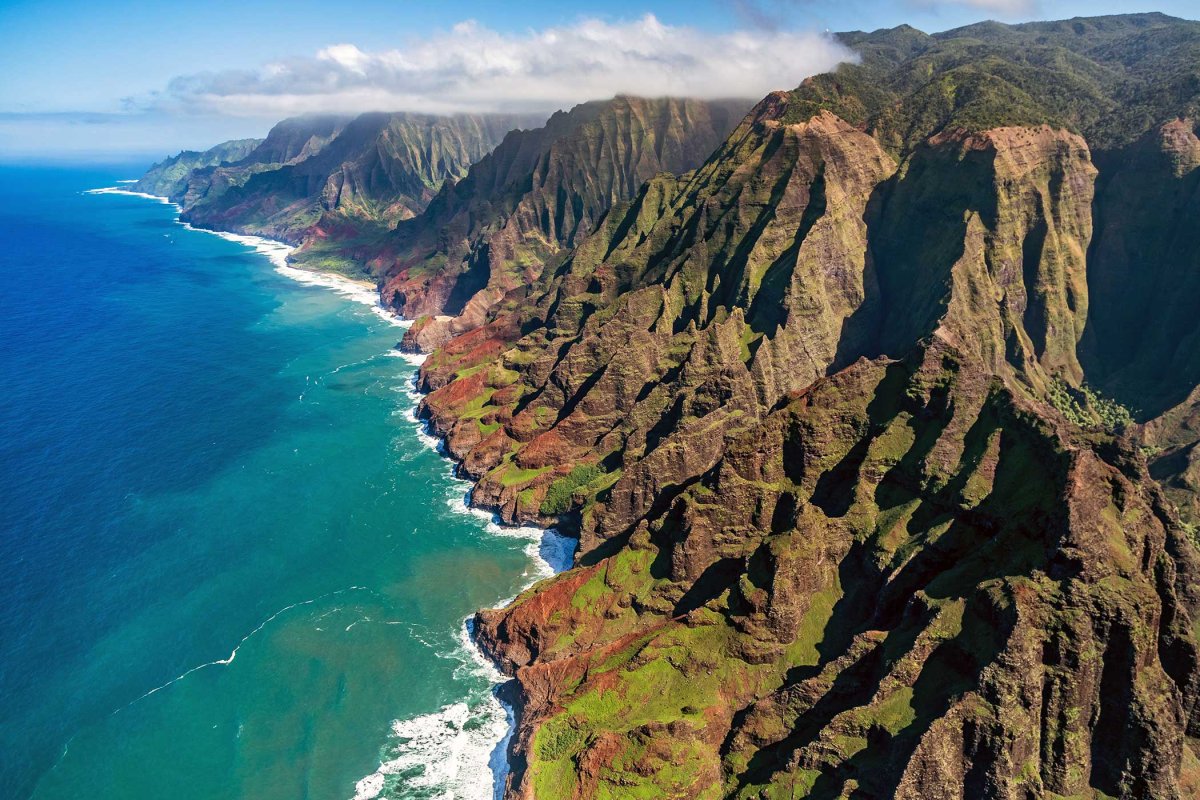
The Na Pali Coast on Kauai’s north shore is 17 miles of fluted emerald cliffs rising 4,000 feet out of the ocean. No road reaches it. Hiking the Kalalau Trail gets you to one end. A boat gets you along the base. But a helicopter puts you inside the valleys — threading between waterfalls, banking over sea caves, hovering above ridgelines that look like the spine of a sleeping dragon.
Blue Hawaiian and Safari Helicopters both run Na Pali tours from Lihue. Blue Hawaiian flies Eco-Star aircraft with floor-to-ceiling windows. Safari offers some tours with waterfall landings. Both also cover Waimea Canyon (“the Grand Canyon of the Pacific”) on the same flight.
Cost: $299-$419 depending on aircraft type and tour length. Doors-off flights (available on select tours through Maverick on Maui and Big Island) run $350-$450. Compare helicopter tour options and book Kauai helicopter tours on Viator.
Other top routes: Big Island volcano circle (fly over Kīlauea’s active caldera and Mauna Kea), West Maui/Molokai sea cliffs (the tallest in the world at 3,000+ feet).
Why it ranks #2: The Na Pali Coast from the air is a once-in-a-lifetime visual. The helicopter is the only way to see the interior valleys, and the scale of the cliffs is impossible to appreciate from ground level. The Big Island volcano route is equally stunning in a different way — molten lava and barren lava fields stretching to the ocean.
3. Paragliding Off Haleakalā
Proflyght Paragliding is the only consistently operating tandem paragliding outfit in Hawaiʻi, and the launch site is one of the best in the world. You take off from Polipoli Spring State Recreation Area on Haleakalā’s western slopes at roughly 3,500 feet and ride thermals over Maui’s Central Valley.
The flight lasts 15-45 minutes depending on thermal conditions. There is no engine noise — just the sound of wind in the canopy and an unobstructed 270-degree view of the Central Valley, the West Maui Mountains, and on clear days, the islands of Molokai, Lanaʻi, and Kahoʻolawe. The descent is gentle, nothing like the violence of skydiving. It is the closest thing to flying like a bird that humans have figured out.
Cost: $175-$250 for a tandem flight. Book early — Proflyght runs limited daily slots and weather cancellations are common.
Why it ranks #3: The silence is what sets paragliding apart. Every other aerial activity involves engine noise. This one is just you, your pilot, and the wind. The Haleakalā launch is world-class terrain, and the views rival the helicopter tours at a fraction of the price.
4. Zipline Through Rainforest Canopy
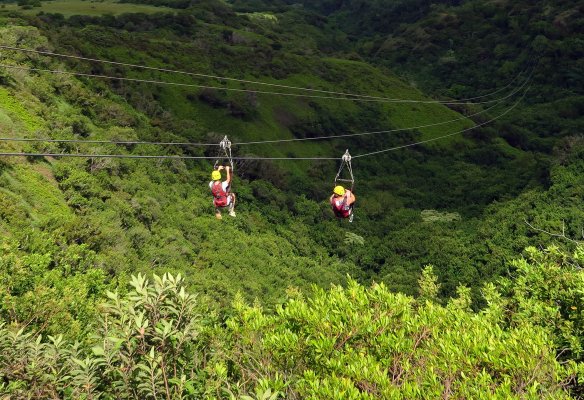
Hawaiʻi has more high-quality zipline courses per square mile than anywhere in the mainland US, and the settings are genuinely spectacular. The best courses fly you through old-growth canopy, over valleys, and alongside waterfalls.
Top picks by island:
Kualoa Ranch (Oahu) — 7 lines through Kaʻaʻawa Valley, soaring over the Jurassic Park and Jurassic World filming locations. The valley is cinematic in a literal sense. $154-$175.
Skyline Eco-Adventures (Maui) — Two courses. The Haleakalā course (5 lines, ~$160) runs through eucalyptus canopy at 3,500 feet. The Kaʻanapali course (8 lines, ~$210) features side-by-side racing lines above West Maui ravines.
Kohala Zipline (Big Island) — 9 lines through old-growth canopy in North Kohala, crossing a valley once used for sugar cane transport. $195. The most immersive rainforest setting of any Hawaiʻi course.
Koloa Zipline (Kauai) — 8 lines over Waita Reservoir on the South Shore. The longest line stretches roughly half a mile. $179. Open ranchland views rather than canopy — a different vibe, equally fun.
Why it ranks #4: Ziplines are the most accessible adventure on this list — no prior experience needed, the fear factor is moderate, and the scenery is consistently excellent. The ranked order above reflects each course’s combination of length, setting, and overall “wow” factor. You can compare and book Hawaii zipline tours on Viator.
5. Shark Cage Diving (or Open Water Shark Swim)
Two operators run shark encounters off Oahu’s North Shore, and they offer very different experiences.
North Shore Shark Adventures takes you 3 miles offshore from Haleiwa Harbor and lowers an aluminum cage into Galapagos shark habitat. The sharks show up reliably — they have been habituated to the boats over years of operation. You do not need any diving experience. The cage sits at the surface, so you are snorkeling, not scuba diving. $130-$150.
One Ocean Diving offers the more intense option: open-water, cage-free swims with sharks. Marine biologists lead the trips, and you float in open ocean while Galapagos and sandbar sharks (occasionally tiger sharks) circle beneath you. It is a conservation-focused operation that uses the encounters to fund shark research. $150-$200.
Why it ranks #5: The fear factor is off the charts for most people, but the reality is calmer than expected. Sharks are not interested in you. The cage version is safe and accessible. The cage-free version is for people who want a genuine “I cannot believe I did that” story.
6. ATV Tours Through Movie Valleys
Kualoa Ranch (Oahu) dominates this category. The 1- and 2-hour ATV tours cover the same Kaʻaʻawa Valley used in Jurassic Park, Jurassic World, Lost, Kong: Skull Island, and 50 First Dates. You ride through mud, up ridgelines, and past filming locations that the guides point out as you go. $89 for 1 hour, $139 for 2 hours.
Kapalua Adventures (Maui) runs ATV tours through the West Maui Mountains above the Kapalua resort area. The terrain is working ranch and former pineapple plantation, with views of Molokai across the channel. $149.
Why it ranks #6: ATV tours are more fun than “adventurous” — the adrenaline factor is lower than the activities above, but the access to otherwise-restricted terrain makes up for it. Kualoa Ranch in particular puts you in landscapes that most visitors only see from the highway.
7. Cliff Jumping (Proceed with Extreme Caution)
Cliff jumping in Hawaiʻi is free, unregulated, and genuinely dangerous. There are no operators, no safety briefings, and no lifeguards at most jump spots. People die at these locations every year. Including it on this list is not an endorsement — it is an acknowledgment that people do it, and a warning to take it seriously if you choose to.
South Point / Ka Lae (Big Island) — A 40-foot jump from the old crane platform at the southernmost point in the United States. The drop is clean, but the currents below are strong and the ladder climb back up is exhausting. Multiple fatalities on record.
Waimea Bay Jump Rock (Oahu) — A 25-foot jump from the boulder on the north side of Waimea Bay. Only remotely safe in summer when the surf is flat. In winter, North Shore swells turn this spot deadly.
China Walls (Oahu) — Ledge jumping into surge channels at Portlock in Hawaiʻi Kai. Unpredictable swells make timing the jump a gamble. Multiple drowning deaths. Local ocean knowledge is essential, and even experienced jumpers get caught.
Why it ranks #7: The thrill is real, but so is the risk. If you go, never jump alone, check conditions obsessively, watch other jumpers first, and understand that “I saw someone else do it” is not a safety plan.
How to Book Smart
Booking directly through operator websites sometimes saves a few dollars, but platforms like Viator offer free cancellation on most tours and make it easy to compare options across operators. Either way, book in advance — popular tours sell out days ahead, especially in peak season. Morning slots generally have better weather for aerial activities (helicopter, paragliding, skydiving) as trade winds and clouds build through the afternoon.
If you are renting a car to reach these activities — and you should, since most are not accessible by public transit — Discount Hawaii Car Rental compares rates across all major agencies and consistently beats booking direct.
A few logistics: skydiving has weight limits (typically 220-230 lbs depending on the operator). Zipline courses require minimum ages of 7-10 and have both minimum and maximum weight restrictions. Helicopter tours rarely have restrictions beyond seatbelt fit but charge a surcharge for passengers over 250 lbs. Check operator websites for specific requirements before booking.
One last thing: the best adventure in Hawaiʻi might not be on this list. It might be the moment you paddle a kayak into Kealakekua Bay and a spinner dolphin pod surfaces around you. Or the first time you drop into a wave at Waikiki on a surfboard. The islands have a way of delivering adrenaline when you are not looking for it.