
Are There Volcanoes on Oahu?
Yes — but they're all extinct, and they haven't erupted in over a million years. Oahu was built by two shield volcanoes: the Wai'anae volcano (western side, 2.5-3.5 million years old) and the Ko'olau volcano (eastern side, 1.7-2.6 million years old). Both are long dead. The Hawaiian hot spot that fuels volcanic activity has drifted southeast and now sits under the Big Island, where Kilauea and Mauna Loa remain active.
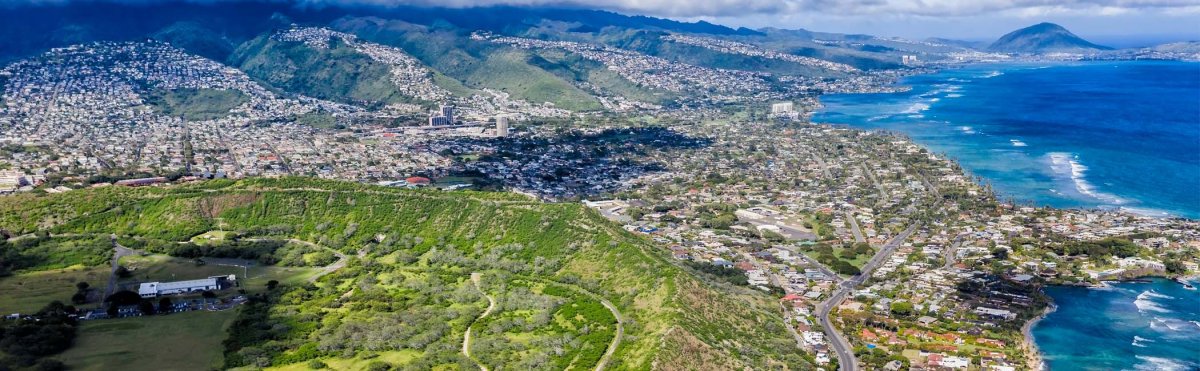
What you CAN visit on Oahu are the volcanic craters left behind — and several of them are among the island's most iconic landmarks. Diamond Head, Koko Head, Hanauma Bay, and Punchbowl are all tuff cones created during a late-stage rejuvenation period about 300,000 to 800,000 years ago, when magma briefly returned to the surface through the eroded remnants of the Ko'olau shield.
Oahu Volcanoes Quick Facts
- Active volcanoes on Oahu: Zero — all extinct
- Last eruption: Approximately 300,000 years ago (Ko'olau rejuvenation stage)
- Volcanic craters you can visit: Diamond Head, Koko Head, Hanauma Bay, Punchbowl
- Best volcanic hike: Diamond Head (1.6 mi roundtrip, reservation required)
- Most challenging: Koko Head Crater (1,048 railroad-tie steps)
- Nearest active volcano: Kilauea on the Big Island (200+ miles southeast)
Oahu's Volcanic Craters You Can Visit
Diamond Head (Le'ahi)
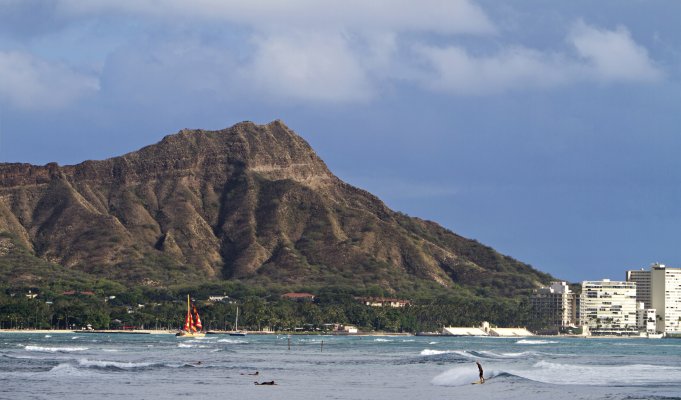
The most famous volcanic landmark in Hawaii. Diamond Head is a 300,000-year-old tuff cone rising 760 feet above sea level on the southeast edge of Waikiki. The name comes from 19th-century British sailors who mistook calcite crystals in the rock for diamonds. Hawaiians call it Le'ahi, likely meaning "brow of the yellowfin tuna" for the shape of its ridgeline.
The hike: A 1.6-mile roundtrip trail climbs from inside the crater to the summit. The trail passes through tunnels and up steep stairs built during World War II when the crater housed military bunkers. The payoff is a 360-degree panorama of Waikiki, Honolulu, and the Ko'olau mountains. Allow about 1.5 hours.
Reservations required: Since 2022, all visitors need advance reservations through the Hawaii State Parks system. Entry costs $5/person (non-residents) plus $10/vehicle for parking. Open daily 6:00 AM - 4:00 PM (last entry).
Koko Head Crater
If Diamond Head is Oahu's most popular volcanic hike, Koko Head is its most punishing. The "Koko Head Stairs" — actually old railroad ties from a WWII tramway — climb 1,048 steps straight up the side of the crater to 1,208 feet. There's no switchback, no shade, and no mercy. The staircase gains about 1,000 feet of elevation in less than a mile.
The trail isn't officially maintained (it's technically a "use at your own risk" path), but hundreds of people hike it daily. Start early — by 7 AM if possible — to avoid the full sun. The views from the top stretch from Hanauma Bay to Diamond Head to the Windward Coast.
Location: Inside Koko Head District Park, near Hawaii Kai. Free, no reservation required. The trailhead is next to the baseball fields.
Hanauma Bay
Most visitors know Hanauma Bay as Oahu's best snorkeling spot, but the bay itself is a volcanic crater. It formed when a tuff cone (similar to Diamond Head) built up on the coast, and one side eroded away — the ocean flooded in, creating the curved bay. The result is a naturally protected swimming and snorkeling area surrounded by volcanic rock walls.
You can clearly see the crater shape from the parking lot overlook before you descend to the beach. The coral reef that formed inside the flooded crater now hosts over 400 species of fish.
Full Hanauma Bay visitor guide
Punchbowl (Puowaina)
Punchbowl is a broad, shallow volcanic crater in the hills above downtown Honolulu. Today it houses the National Memorial Cemetery of the Pacific, the final resting place for over 53,000 U.S. service members. The Hawaiian name, Puowaina, means "hill of sacrifice."
The crater formed about 75,000-100,000 years ago in a brief explosive eruption. Unlike Diamond Head's steep walls, Punchbowl's rim is low and gentle — it looks more like a stadium than a mountain. Visitors come primarily for the cemetery and its views of Honolulu, not for hiking, but the geological context adds a layer of gravity to the site.
Entry: Free. Open daily 8:00 AM - 5:30 PM (extended hours on some holidays). Driving directions are straightforward from downtown Honolulu.
Oahu's Volcanic Geology: How the Island Formed
Oahu exists because the Pacific Plate drifts northwest over a stationary volcanic hot spot in Earth's mantle. Each Hawaiian island formed as the plate carried fresh crust over the hot spot, allowing magma to push through and build a volcanic island. Then the plate moved on, cutting the island off from its magma source.
Oahu's construction happened in phases:
- 3.5-2.5 million years ago: The Wai'anae shield volcano built the western half of Oahu.
- 2.6-1.7 million years ago: The Ko'olau shield volcano built the eastern half, eventually merging with the Wai'anae remnant to form a single island.
- 800,000-300,000 years ago: A "rejuvenation stage" produced the tuff cones and craters you see today — Diamond Head, Koko Head, Hanauma Bay, Punchbowl, Salt Lake, and others. This stage is over.
Today, Oahu is eroding. The Ko'olau range loses measurable height each year to rainfall and wind. In a few million years, Oahu will be a low atoll like Midway, and eventually disappear beneath the waves entirely. That's the lifecycle of every Hawaiian island.
Can a Volcano Erupt on Oahu?
Practically, no. The hot spot is now about 200 miles southeast, under the Big Island's Kilauea and Mauna Loa. There's even a new seamount called Lo'ihi forming on the ocean floor southeast of the Big Island — it'll break the surface in about 10,000-100,000 years and become Hawaii's newest island.
Geologists classify Oahu's volcanoes as extinct, not merely dormant. The rejuvenation stage that created Diamond Head was the final chapter. There's no magma pathway, no seismic activity suggesting renewed volcanism, and no geothermal heat signature beneath Oahu's craters.
If you want to see an active volcano, head to the Big Island's Hawaii Volcanoes National Park. Kilauea has been erupting intermittently since 1983 and is one of the most accessible active volcanoes on Earth.