Hawaiʻi Guide · Audio Driving Tour
North Shore Drive BETA
The classic Kamehameha Highway run along Oahu's North Shore — Haleiwa Town, the green-sea-turtle beach at Laniakea, Waimea Bay, the snorkel cove at Sharks Cove, Banzai Pipeline, Sunset Beach, the resort at Turtle Bay, and the shrimp trucks of Kahuku. ~12 curated segments. Free AI-narrated audio companion.
17 miles
21 min driving
9 curated stops
Free AI-narrated tour
21 min
driving time
17 mi
total distance
9 stops
curated stops
~4h
suggested day
We may link to trusted Hawaiʻi resources at no extra cost to you.
Route Map
9 stops
·
active stop
Loading map…
Build your own route
Pick a preset or tap the ✓ Include chip on any stop below to customize.
9
of 9 stops selected
-
Intro
Intro
Show transcript
The North Shore drive is 17 miles along Kamehameha Highway from Haleiwa Town out to Kahuku. The whole stretch takes about 35 minutes if you don't stop, but that's not the point. You're going to stop. A lot. World-famous surf breaks, green sea turtles basking on the sand, the best snorkel cove on the island in summer, the resort at the north tip, and shrimp trucks at the end. Plan a full day if you want to swim, snorkel, or watch the surf. Half a day if you're driving through. Two things to know up front. First — in winter (November through February) the surf on this stretch is enormous and lethal. Stay out of the water at Waimea, Pipeline, and Sunset unless you genuinely know what you're doing. Sharks Cove looks calm but is also closed-out in winter. Second — parking at Laniakea (the turtle beach) is ranger-controlled now. You pull off, a ranger waves you into a space, you watch the turtles from the sand, you leave. No more chaos on the highway shoulder. The guide will announce each stop as it comes up. -
83MILE0
Haleiwa is the gateway to the drive. Last gas before Kahuku, full grocery + restaurant scene, surf shops, shave ice. Coordinates approximate.
Approach Cue (~12-15 sec)Show transcript
Haleiwa Town coming up — the start of the drive. Pull in and use it. Last gas until Kahuku, 17 miles ahead. Coffee, breakfast, surf shops, shave ice. Two shave ice spots compete for the line out front: Matsumoto's and Aoki's, both original, both worth the wait.Arrival Narration (~45-60 sec)Show transcript
Welcome to Haleiwa. This was the plantation town of the North Shore — sugar mills, rail depot, fishing harbor — and it grew into the surf-town hub it is today after surfing arrived in the 1960s and 70s. The buildings on the main strip are deliberately preserved old plantation: wooden facades, false fronts, tin roofs. Matsumoto's Shave Ice has been here since 1951. Aoki's, just down the strip, has been here since the 1980s. Both serve the same dish in roughly the same way and locals have firm opinions on which is better. Try one. Past the shops, the harbor at the end of Haleiwa Beach Road is where most of the North Shore boat tours launch — turtle snorkels, dolphin watches, sunset sails. If you want food, the lineup is good: poke at Joes' on the Green or Fresh Catch, plate lunch at Haleiwa Joe's, big breakfast at Haleiwa Beach House. Top off the tank at the Chevron near the bridge. You're heading north now on Kamehameha Highway, Hawaii Route 83. The turtle beach is about three miles ahead. -
Connector · 83 4 min drive · 3 mi
Haleiwa to Laniakea Connector
Show transcript
You're past the Anahulu Stream bridge — the iconic arched concrete bridge with the rainbow paint job — and onto the open coastal stretch. The land flattens out here and the Pacific opens up to your left. In winter you'll see white water on the horizon when the swell is up. The first beach you'll pass on the makai side is Pua'ena Point — surfers and swimmers. Then a long open stretch of cane-field flats. Laniakea — the turtle beach — is coming up in about a mile. Watch for the ranger waving you in. If the lot's full, you'll get directed to keep going. -
4 min from previous stop · 3 mi83MILE3
Turtle Beach. Honu basking spot. Parking is now ranger-managed (started ~2024) to fix the highway-shoulder chaos. Free.
Approach Cue (~12-15 sec)Show transcript
Laniakea coming up on the left in about a quarter mile. This is the turtle beach — green sea turtles, honu, hauling out on the sand to bask in the sun. The parking is ranger-controlled now, so look for the staff on the side of the road waving cars in. It's free. If they wave you on, the lot is full and you'll need to come back later. There's no waiting in the lane.Arrival Narration (~45-60 sec)Show transcript
You're at Laniakea, known as Turtle Beach. The honu — Hawaiian green sea turtles — come up onto the sand here to thermoregulate, basically to warm themselves in the sun after foraging in the cold ocean. You'll usually see between two and ten of them on the beach at any given time, sometimes more. The volunteer rangers from Mālama na Honu rope off a perimeter — stay outside it. The federal rule is simple: ten feet of distance, no touching, no flashing lights. Honu are protected under the Endangered Species Act and the Marine Mammal Protection Act. The fines for harassment start in the thousands. Beyond the turtles, the beach itself is fine for a quick walk — shore break is dangerous in winter, swimmable in summer. Plan ten or fifteen minutes here. The next stop is Waimea Bay, two miles ahead. -
3 min from previous stop · 2 mi83MILE5
The big-wave landmark of the North Shore. Eddie Aikau Big Wave Invitational held here when surf reaches 30+ ft. Has only run ~10 times in its history (last in 2023).
Approach Cue (~12-15 sec)Show transcript
Waimea Bay coming up on the left. This is the bay — the big-wave bay. In summer, calm water and one of the best swimming beaches on the island, with a famous jump rock on the south point. In winter, this is where 30 to 50 foot waves break, and where the Eddie Aikau Big Wave Invitational runs in the rare years when conditions are right. Parking lot is on the makai side across from the bridge. It fills early on summer weekends. The Foodland grocery is across the street if you need water or snacks.Arrival Narration (~45-60 sec)Show transcript
Waimea Bay is one of the most photographed bays in the state. In summer the water is glass-flat and turquoise — kids jumping off the rock, families swimming, locals fishing on the south point. In winter, this place transforms. The bay funnels north swells into 30, 40, sometimes 50-foot waves, and the only people in the water are big-wave specialists who know what they're doing. The Eddie Aikau Big Wave Invitational, named after the legendary Hawaiian waterman who died in 1978 crewing the Hokule'a's ill-fated voyage, has only run about ten times in its 40-year history — it requires waves to consistently top 30 feet at the bay, and that's a narrow window. The motto is true: "the bay calls the day." If you're here in summer, swim. The jump rock on the south point is roughly 25 feet up and jumping is at-your-own-risk — lots of people do it, plenty break ankles. If you're here in winter, watch from the parking lot or the bluff — the water is genuinely lethal. Across the street is the entrance to Waimea Valley, an optional side trip with a botanical garden and a swimmable waterfall. Next stop is Sharks Cove, half a mile up the road. -
1 min from previous stop · 0.5 mi83MILE5.5
Optional side trip — a botanical garden valley with a swimmable waterfall at the end. Entry fee. Plan 2-3 hours if you go in.
Approach Cue (~12-15 sec)Show transcript
Waimea Valley entrance coming up on the mauka side, right at the bridge. This is an optional side trip. If you go in, plan two to three hours and paid admission — you walk a paved 3/4-mile path through a botanical garden and end at Waihi Falls, where you can swim under the waterfall in a lifeguarded pool. If you're short on time, skip it and continue to Sharks Cove.Arrival Narration (~45-60 sec)Show transcript
Waimea Valley is a 1,800-acre cultural site and botanical garden run by a nonprofit, Hi'ipaka LLC, and it's one of the more meaningful stops on the North Shore. Hawaiian families lived in this valley for nearly a thousand years. The trail in passes restored hale (traditional houses) and gardens organized by Polynesian region — Hawaii, Tahiti, Samoa, Aotearoa. The garden contains nearly 5,000 species of tropical plants, the largest collection in the state. The walk to the waterfall is paved and stroller- accessible, about 3/4 of a mile each way. At the end, Waihi Falls drops 45 feet into a pool the staff opens for swimming when conditions are safe — lifeguards on duty, life vests required for non-swimmers, free with admission. The water is cold — high-mountain stream cold — and the experience of swimming under a Hawaiian waterfall makes the side trip worth it. Two to three hours start to finish. Back on Highway 83, Sharks Cove is half a mile north. -
1 min from previous stop · 0.5 mi83MILE6
Sharks Cove is part of Pupukea Marine Life Conservation District. Best snorkeling on the North Shore — but only in summer (May-Sep). Lethal in winter.
Approach Cue (~12-15 sec)Show transcript
Sharks Cove coming up on the left. Best snorkeling on the North Shore — but only in summer when the surf lays down. From May through September the water inside the cove is calm and you'll see reef fish, eels, sometimes a turtle. From October through April this place is closed-out by surf and should not be entered. Parking is across the street at Pupukea Beach Park. The food trucks across the street are good — try the garlic shrimp or the poke bowls.Arrival Narration (~45-60 sec)Show transcript
Sharks Cove is a small, rocky cove protected by a lava-rock breakwall — the breakwall is what makes it the calmest snorkel spot on the North Shore in summer. The whole area is part of the Pupukea Marine Life Conservation District, established in 1983 — fishing is prohibited, the reef is protected, fish populations are dense. You'll see yellow tangs, butterflyfish, moorish idols, parrotfish, and the occasional honu. Despite the name, you will not see sharks here. Entry is from the rocks on the south end. Bring reef-safe sunscreen, water shoes (the rocks are sharp), a snorkel kit. Don't swim outside the cove — currents pick up fast. In winter — November through April — the surf closes this whole area out. Don't enter the water in winter. The food trucks across the street have garlic shrimp and poke bowls; if you're hungry, this is a good lunch stop. Sunset Beach is two miles ahead, with Pipeline coming up first. -
2 min from previous stop · 1 mi83MILE7
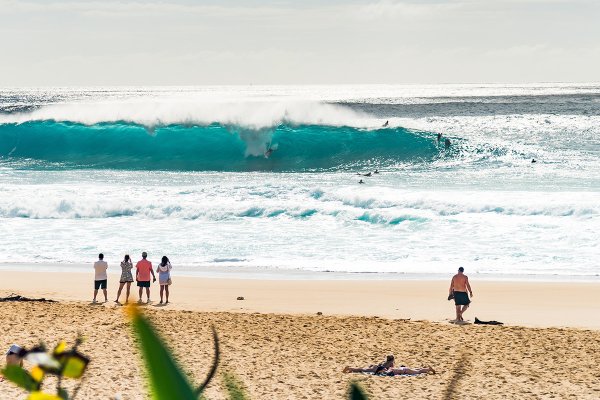
Ehukai Beach Park is the parking lot. The wave breaks offshore — that wave is Banzai Pipeline. World's most photographed surf break. The Vans World Cup of Surfing runs here in late December.
Approach Cue (~12-15 sec)Show transcript
Ehukai Beach Park coming up on the left. Park here. The wave breaking offshore is Banzai Pipeline — the most photographed surf break in the world. It's a left and a right barrel that breaks over a shallow reef, and in winter it's the heaviest wave you can watch from the sand. In summer the beach is just a beach — a wide stretch of sand, swimmable, no crowds. The parking lot fills fast in winter when the swell is up; if it's full, keep going to Sunset.Arrival Narration (~45-60 sec)Show transcript
You're at Ehukai Beach Park, but everyone calls it Pipeline because that's the name of the wave. The wave breaks roughly 75 yards offshore on a shallow lava-rock reef, and that shallow reef is what makes it so dangerous. A 10-foot wave at Pipeline is breaking in roughly 10 feet of water with sharp coral underneath. Surfers have died here. The Vans World Cup of Surfing runs in mid-December and the Pipe Masters runs at the end of the year — both major events on the world surf tour. If you're here in winter and the surf is up, walk to the lifeguard tower, sit on the sand, and watch. It's free and it's one of the great spectator experiences in surfing. In summer, the beach is just a wide stretch of soft sand, good for a swim, no crowds. The bunker on the south end of the beach built by the U.S. military during World War II is still there — concrete, half-buried in dunes. Sunset Beach is one mile ahead. -
1 min from previous stop · 1 mi83MILE8
Sunset Beach is a 2-mile stretch — the parking lot for the surf break is at the south end. The Vans Triple Crown of Surfing's first event, the Hawaiian Pro, runs here in November.
Approach Cue (~12-15 sec)Show transcript
Sunset Beach coming up on the left. The beach itself runs for two miles — the parking lot for the surf break is at the south end where the cars are lined up. In winter this break holds 15 to 25 foot swells and is one of the longest waves on the North Shore. In summer it's a calm beach, good for swimming, with a reliable sunset every evening that gave the place its name.Arrival Narration (~45-60 sec)Show transcript
Sunset Beach is the longest beach on the North Shore — about two miles end to end — and the surf spot at the south end is one of the proving grounds of competitive surfing. The Vans Triple Crown of Surfing's first event, the Hawaiian Pro, runs here in mid-November and then moves to Pipeline. The wave at Sunset is a long right-hand break — surfers will paddle for it from a wide takeoff zone and ride it for a quarter mile in big swell. In summer, the surf flattens out and the beach is one of the best swimming spots on the North Shore — just be aware of strong rip currents even in calm conditions. The view to the west, especially at sunset (which is how the place got its name) is genuinely one of the best on Oahu — the sun drops straight into the Pacific with the silhouette of Kaena Point in the distance. The next stop is Turtle Bay, three miles ahead. -
Connector · 83 4 min drive · 3 mi
Sunset to Turtle Bay Connector
Show transcript
You're past Sunset now and heading toward the north tip of the island. The road curves inland for a stretch — old plantation country, polo fields, horse stables on the mauka side. This was Kawailoa Sugar Plantation land for most of the 20th century, and a lot of it is still open agricultural land now. About a mile ahead the highway swings back toward the coast and you'll see the resort at Turtle Bay come into view on the makai side — the only resort on the North Shore, sitting on its own peninsula at the very northern tip of Oahu. -
4 min from previous stop · 3 mi83MILE11
Property rebranded to The Ritz-Carlton Oʻahu, Turtle Bay in July 2024. Beach access is public — Kuilima Cove is the protected snorkel spot just east of the resort.
Approach Cue (~12-15 sec)Show transcript
Turtle Bay coming up on the makai side. The resort is now The Ritz-Carlton Oʻahu, Turtle Bay — rebranded in 2024. Public beach access on the resort side: drive into the property, follow signs for "public beach access," park in the designated lot. Kuilima Cove, just east of the main resort beach, is a protected snorkel spot — calm year-round and good for kids.Arrival Narration (~45-60 sec)Show transcript
Turtle Bay sits on the only point of land that pushes out from the North Shore, and that position gives the property a wraparound view of the Pacific that you can't get anywhere else on the island. The resort itself was opened in 1972 as Kuilima Resort, became Turtle Bay in 1992, and rebranded as The Ritz-Carlton Oʻahu, Turtle Bay in July 2024 after a multi-year renovation. Beach access is public — drive onto the property, follow the signs to public parking, walk down to the sand. Kuilima Cove is the small protected cove just east of the main beach, and it's one of the few places on the North Shore where snorkeling is reliable year-round — the rock outcrop blocks the winter swell. In summer the main beach in front of the resort is also swimmable, with calm water and a soft bottom. If you want lunch on the lanai, the open-air restaurant at the resort runs an affordable noon menu. Past Turtle Bay, you're on the final stretch to Kahuku — the last town on this drive — about three miles ahead. -
4 min from previous stop · 3 mi83MILE14
Kahuku is a former sugar plantation town. Shrimp trucks run along Kamehameha Highway just south of town — Giovanni's, Romy's, and Fumi's are the originals. Shrimp comes from local aquaculture ponds.
Approach Cue (~12-15 sec)Show transcript
Kahuku coming up — the last town on this drive. The shrimp trucks are strung out along Kamehameha Highway as you enter town, mostly on the mauka side. Three originals: Giovanni's (the famous one with the graffiti truck), Romy's (the local favorite), and Fumi's (the one with the pink trailer). All three serve garlic shrimp on rice — that's the dish — and the shrimp comes from aquaculture ponds you can see on the mauka side as you approach.Arrival Narration (~45-60 sec)Show transcript
Kahuku was a sugar plantation town from 1890 until the mill shut down in 1971, and what filled the economic vacuum afterward was shrimp farming. The aquaculture ponds you saw on the mauka side as you came in produce most of the shrimp the trucks here serve. The classic order is garlic shrimp on a styrofoam plate over white rice — twelve big shrimp, head-on, shells-on, drowned in butter and crushed garlic, served with two scoops of rice and a slice of pineapple. Eat with your hands. Three originals compete for the line. Giovanni's is the famous one, the white truck covered in graffiti, parked at the south end. Romy's, just down the road, is the local favorite — slightly cheaper, slightly bigger portions, shorter line. Fumi's is the third — pink trailer, family-run, smaller operation, every bit as good. Locals will fight you on which is best. They're all worth eating. Plan twenty or thirty minutes for the wait plus the meal. -
Outro
Outro
Show transcript
That's the North Shore drive. From Haleiwa Town, past the turtle beach at Laniakea, the big-wave bay at Waimea, the snorkel cove at Sharks Cove, the reef break at Pipeline, the long sand at Sunset, the resort at Turtle Bay, and the shrimp trucks at Kahuku. From Kahuku, you have two ways back to Honolulu. The fast way is to keep going east on Kamehameha Highway, drop down through Hauʻula and Kaʻaʻawa to Kāneʻohe, and pick up Likelike or Pali Highway over the Koʻolau Mountains — about an hour and 15 minutes back to Waikīkī. The other way is to turn around here and retrace the North Shore back to Haleiwa, then take the H-2 freeway south through the central plains. Both are about the same length. The Windward route is prettier and has more to see; the freeway route is faster. Tomorrow, check the East Side drive on Kalanianaʻole Highway — Diamond Head to Hanauma Bay to Makapuʻu — or the Pali Highway up to the lookout. Both are shorter, both very different.
AI-narrated audio synthesized by ElevenLabs, voiced by Hoku (feminine) and Honu (masculine). Hoku and Honu are Voice Library donors, not native Hawaiian speakers. Some pronunciations may land slightly off — mahalo for your patience as we refine.

Try out our AI Powered
Search & Chatbot →

Get Your Free Hawaii Visitor Guide
Enter your email and we'll send you instant access to our free 2026 Hawaii Starter Guide + Summary Guidesheets.