
Maui Sights
Bailey House Museum (Hale Hoʻikeʻike)
Most travelers driving up Main Street in Wailuku on their way to Iao Valley pass right by an unassuming two-story stone-and-wood house tucked behind a low rock wall on the right side. That's the Bailey House — built between 1833 and 1850 by the missionary couple Edward and Caroline Bailey — and since 1957 it has housed Maui's main historical museum, Hale Hoʻikeʻike, operated by the Maui Historical Society.
It's the oldest western-style house on Maui still standing on its original foundation, and one of the few buildings in the islands that has continuously held a cultural use since the 19th century. Inside, it's a working museum — modest, well-curated, and far more interesting than its quiet street presence suggests.
Book Tours & Activities on Maui
Free cancellation on most tours. Real pricing and verified traveler reviews.
Check Availability & Pricing Browse all Maui toursWhat you'll see inside
The museum is small enough to walk through in 45 minutes to an hour, but it covers a wide stretch of Maui history:
- Hawaiian cultural artifacts — kapa cloth, calabash bowls, fishing implements, stone tools, and feather work, much of it predating Western contact. The Bailey family began collecting these in the 19th century, and the collection has grown through community donations.
- Edward Bailey paintings — Edward Bailey was a competent landscape painter, and his oil paintings of pre-tourism Maui (Wailuku, the Iao Valley, the West Maui Mountains, the Kahului plain) are some of the only surviving visual records of what those places looked like in the mid-1800s.
- Missionary-era furnishings — original Bailey family rooms preserved with period furniture, kitchen tools, and personal effects. The koa-wood interiors are striking on their own.
- Whaling and plantation exhibits — small but informative sections on the whaling era (Lahaina was once one of the world's busiest whaling ports) and the early sugar plantations that shaped central Maui.
The Bailey family and the original site
The house began life as part of the Wailuku Female Seminary, a missionary-run school for Hawaiian girls that opened in 1837. Edward Bailey took over as principal in 1840, and he and Caroline lived in and expanded the building over the next decade. After the seminary closed in 1849, the Baileys stayed on, and the house remained in the family's care until the Maui Historical Society acquired it. The original stone foundations and koa-wood beams are still in place — you're walking through actual mid-19th-century construction, not a reconstruction.
Hours and admission
Open Tuesday through Friday, 10 a.m. to 2 p.m. Closed Saturday, Sunday, and Monday. The museum is volunteer-staffed, so the schedule can shift around federal holidays — confirm via the Maui Historical Society's Hours & Admission page before driving out, or call (808) 244-3326.
Admission (as of the museum's current published rates):
- Adults: $10
- Seniors (65+): $8
- Students (with ID): $5
- Children ages 5–18: $4
- Children ages 1–4: free
- Kamaʻāina: 50% off all of the above with a valid Hawaii ID
The on-site virtual tour mobile app is included with admission — worth opening on your phone before you start through the rooms.
Where it fits in a Maui trip
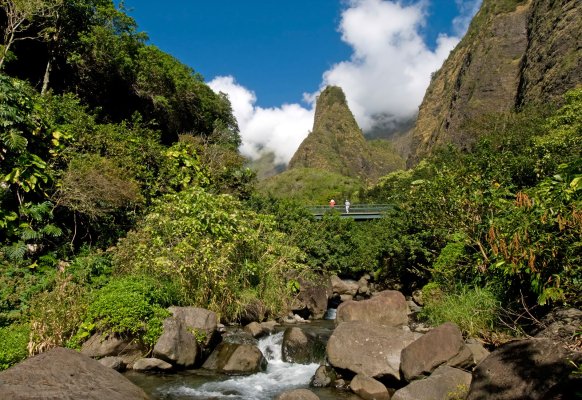
The Bailey House pairs naturally with a half-day of central Maui sightseeing. From Kahului you can string together Wailuku town for breakfast or lunch, the Bailey House for an hour, and then drive 10 minutes up Iao Valley Road for the Iao Valley Needle. The whole loop takes 3 to 4 hours and gives you the cultural and the geological context for the same valley in a single morning.
If you have extra time, Kepaniwai Heritage Gardens sits between the Bailey House and the Iao Needle and is also free to walk through. It commemorates the various ethnic communities that built modern Maui — Hawaiian, Chinese, Japanese, Filipino, Korean, Portuguese — with replica architecture from each.
Practical notes
- Parking: a small free lot on-site, plus street parking on Main Street.
- Accessibility: the historic building has stairs and tight doorways; not all rooms are wheelchair-accessible. Call ahead if access is a concern.
- Time needed: 45–60 minutes is plenty unless you want to read every label. Allow longer if you're a history reader.
- Photography: usually permitted indoors without flash; ask at the front desk to confirm for the current rotation.
- Gift shop: small, with locally-made items, books on Maui history, and reproductions of Edward Bailey paintings.
Get Your Free Maui Guide
Instant access — opens immediately
- Beaches, activities & top spots
- Restaurant & dining recommendations
- Maps, itineraries & insider tips
Want the full offline version? Get the Complete Maui Guidebook →