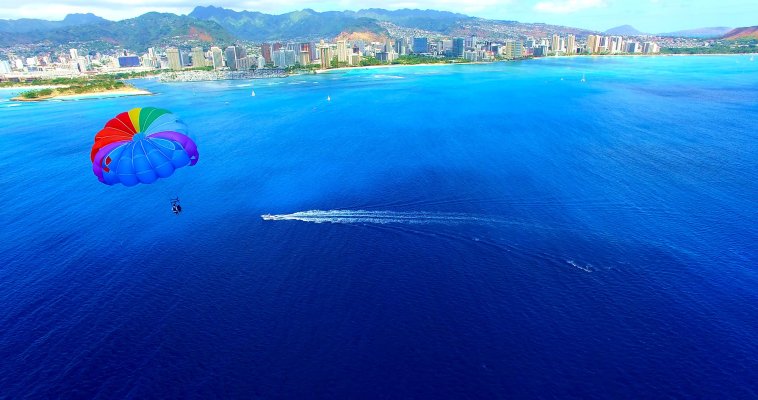

The West Maui Coast From 800 Feet Up
Parasailing is one of the easiest bucket-list activities on Maui. You show up at the Kaanapali beach pickup, a Zodiac runs you out to the parasail boat a few hundred yards offshore, they strap you into a harness, and the winch pays out the line until you're dangling under a colorful chute somewhere between 800 and 1,200 feet above the water. No training, no swimming required, no real athletic component. If you can sit in a chair, you can parasail.
The part most first-time visitors don't know: commercial parasailing on Maui shuts down for roughly half the year. It's not a scheduling quirk — it's because humpback whales are in the channel.
Whale-Season Closure (Operator Policy)
Maui parasail operators suspend operations during humpback whale season — typically mid-December through mid-April or mid-May, depending on the operator. UFO Parasail, for example, publishes a season window of May 16 through December 14 and switches its fleet to whale watching for the rest of the year. Exact start and end dates vary year to year and operator to operator — always confirm with the operator before booking.
Humpback whale season in Hawaiian waters runs roughly November through April or May (per NOAA's Hawaiian Islands Humpback Whale National Marine Sanctuary). Parasail lines and an uptick of mothers with calves in the Auau Channel are a bad mix, and operators voluntarily park their boats during the peak of the season.
If you're visiting in peak whale season, parasailing is off the table on Maui. Book a whale-watching tour instead — you'll actually be out on the water with the reason the parasail boats are parked.
Where the Boats Launch From
Every commercial Maui parasail operator works out of Kaanapali on the west side, launching from the beach in front of the resort strip. You walk down from your hotel (Kaanapali Beach Hotel, Westin, Sheraton, Hyatt Regency, Royal Lahaina) to the sand, meet the boat crew at a pickup point, and they run you out via tender. The sunrise and mid-morning departures tend to have the calmest water and the smallest crowds. Afternoon winds pick up and the ride gets bumpier.
Ride Height Options
The two standard tiers on Maui are 800-foot and 1,200-foot rides. Longer line = higher altitude = longer ride, but also more exposure to wind and a longer walk back down the line to the boat.
- 800 feet (standard): ~10–12 minutes of flight time. The sweet spot. Plenty high to see the entire Kaanapali coastline and out to Molokai and Lanai on a clear day.
- 1,200 feet (deluxe): ~12–15 minutes. The premium option. On a calm day this is one of the best views in Hawaii. On a windy day it's a workout — bring someone you don't mind getting airsick with.
Public flights typically start around $90–$100 per person for the 800-foot ride, with 1,200-foot tiers running into the low-to-mid $100s. Rates change year to year — always confirm with the operator before booking.
Age, Weight & Health Requirements
- Minimum age: Usually 5 or 6, but solo flights typically require 8+. Tandem flights (two riders on one chute) are how younger kids fly.
- Minimum weight: Usually 130 lbs solo — under that you'll need a tandem partner to stay aloft.
- Maximum weight: Usually 425–450 lbs combined (tandem), or around 250 lbs solo. Operators weigh you at check-in.
- Pregnancy: Not permitted. No exceptions.
- Back or neck issues, recent surgery: Disclose before booking — the landing has a small but real jolt and the harness tightens around your hips.
- Fear of heights: Honestly, parasailing feels more like sitting in a chair than falling. Most people who are nervous about heights do fine.
Kaanapali Parasail Operators (Whale-Season Hiatus Permitting)
Two longtime operators run out of Kaanapali. Both are family-friendly, both are licensed, and both are bookable through the links below. We list them alphabetically.
- UFO Parasail — one of the original Hawaii parasail operators. 800 and 1,200 ft ride options, check-in on Kaanapali Beach fronting Whalers Village.
- West Maui Parasail — family-owned, similar ride heights, Kaanapali launches.
The easiest way to compare current pricing and departure times is through Maui parasail listings on Viator » — filter for Kaanapali and pick your preferred height.
When to Book
→ First or second departure of the day. Light winds, glassy water, best photos.
→ Mid-afternoon departures. Bumpier ride, but shorter wait and sometimes discounted.
→ Roughly mid-May through mid-December, varies by operator. Book early (May/June) for fewer crowds.
→ Swap to a whale-watching tour — same boats, different mission.
What to Bring, What to Leave Behind
- Bring: Reef-safe sunscreen (zinc-based — these ones are mandatory by Hawaii law), a hat with a chin strap, sunglasses with a retainer, a GoPro with a chest mount if you want photos.
- Leave behind: Phones, loose jewelry, anything you'd cry about losing to the ocean. Some rides stay dry; others end with a splashdown.
- Wear: A swimsuit under shorts. You won't be fully in the water but you may end the ride with wet feet and a wet butt.
- Don't eat a huge breakfast. The tender ride out is bouncy. The parasail itself is smooth — the boat is the part that gets people.
Is It Worth It?
If you've already done a snorkel trip to Molokini and a helicopter tour, parasailing is the small third act — a short, cheap thrill with a view you can't get any other way. Twelve minutes at 800 feet above the Kaanapali coastline gives you a perspective on West Maui's geography that you won't forget. It's not the trip, but it's a great one-hour morning.
If you're visiting in whale season, save the money and the boat time for a whale-watching tour instead. Seeing a 40-ton humpback breach 30 feet from a catamaran is the better story anyway.
Related reading: Maui whale watching · Maui snorkeling tours · Kaanapali Beach · West Maui guide