Hawaiʻi Guide · Audio Driving Tour
Haleakalā Summit Drive BETA
A 36-mile climb up Hawaii Routes 377 and 378 from upcountry Maui to the summit of Haleakalā at 10,023 feet. Switchbacks, silverswords, the view from Leleiwi, sunrise from the visitor center, the observatory complex at the top. Plan 3+ hours one way. ~7 curated segments. Free AI-narrated audio companion.
36 miles
1h 11min driving
6 curated stops
Free AI-narrated tour
1h 11min
driving time
36 mi
total distance
6 stops
curated stops
~4h
suggested day
We may link to trusted Hawaiʻi resources at no extra cost to you.
Route Map
6 stops
·
active stop
Loading map…
Build your own route
Pick a preset or tap the ✓ Include chip on any stop below to customize.
6
of 6 stops selected
-
Intro
Intro
Show transcript
The drive to the summit of Haleakalā is 36 miles from upcountry Maui to 10,023 feet — one of the steepest paved ascents in the United States. The summit is colder than you think. Plan for 30 to 50 degrees Fahrenheit at the top, with wind, even when Kīhei is 85 degrees. Bring a fleece, long pants, and closed-toe shoes. Plan three hours minimum each way if you stop at the overlooks. There's no gas above Pukalani, no food above the park entrance, and very limited cell service inside the park. Fill the tank before the climb. A few practical notes. Park entry is $30 per vehicle and the ticket is good for three days, also covers Kīpahulu (Seven Sacred Pools). Sunrise viewing requires an advance reservation at recreation.gov, $1 per vehicle, released 60 days out and gone in under 24 hours — no walk-ups before 7 AM. After 7 AM the park is first-come. Sunset viewing has no reservation requirement. The road is paved and well maintained the entire way. The guide will announce each overlook as it comes up. -
 378MILE0Stop · mile 0 makai
Pukalani Junction
Pukalani is the last gas + grocery before the summit. Foodland Pukalani is on the makai side at the junction; Crater Road (Hwy 377 → 378) climbs from here.
Approach Cue (~12-15 sec)Show transcript
Pukalani coming up — this is the launch point. Foodland is on the makai side at the junction. Last full grocery, last gas station, last reliable bathroom stop before the climb. There's a small Aloha gas station, a coffee spot, and a couple of plate lunch places. If you didn't eat or pack water, do it here. The next 36 miles are pasture, then forest, then alpine desert.Arrival Narration (~45-60 sec)Show transcript
Pukalani sits at 1,600 feet, on the western flank of Haleakalā. The town is a working upcountry residential area — cattle pasture on the slopes around it, a few small shopping centers near the highway, and a school. Most of the restaurants and groceries on Maui's upcountry strip — Makawao town, Kula Lodge, Komoda Store Bakery — are 5 to 10 minutes away on Hwy 37 if you have time. From here, turn mauka onto Haleakalā Highway, which is signed as Hwy 377. About six miles up, Hwy 377 ends and you'll merge onto Hwy 378 — Crater Road — the road that switchbacks all the way to the summit. The road is paved and well maintained but the curves are tight and constant. Pace yourself. The first overlook inside the park is Leleiwi, at about 8,800 feet — that's about 25 miles ahead. -
25 min from previous stop · 11 mi378MILE11
Haleakalā NP entrance station. $30 per vehicle, good for 3 days, also covers Kīpahulu. Hosmer Grove campground sits 1 mi inside the gate — the first restroom and short trail inside the park.
Approach Cue (~12-15 sec)Show transcript
Haleakalā National Park entrance coming up. $30 per vehicle, good for three days, covers both this side of the park and Kīpahulu down by Hāna. America the Beautiful Pass works here — show it at the booth and skip the fee. If you're here for sunrise, your reservation barcode goes to the ranger at the gate. After the gate, Hosmer Grove campground is one mile in on the left — restrooms, a short forested loop trail, and the first place to step out and feel the temperature drop.Arrival Narration (~45-60 sec)Show transcript
You're at the Haleakalā National Park entrance, 7,000 feet. The fee covers both this side and Kīpahulu down on the Hāna coast for three days, so if you're driving the Hāna highway later in the trip, the same ticket gets you into the Seven Sacred Pools without paying twice. Hosmer Grove, one mile inside the gate on the left, is worth ten minutes — it's a stand of non-native trees that early-1900s territorial foresters planted as an experiment to see what would survive at this elevation. Most of them did. The half-mile loop trail through the grove is the first place you can hear native forest birds — ʻiʻiwi, ʻapapane — and the picnic shelter is a good place to put on a layer. From here, the road climbs hard. Leleiwi Overlook is about nine miles ahead. -
 18 min from previous stop · 7 mi378MILE18
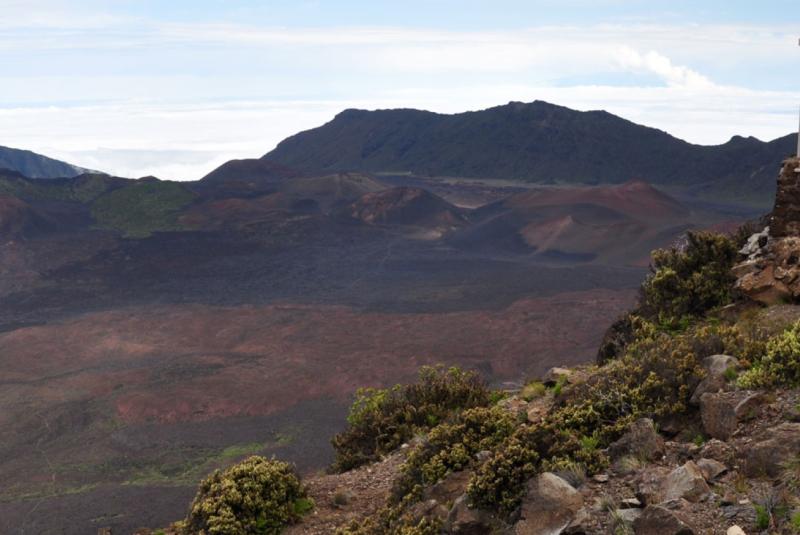
First overlook with a crater view. ~8,800 ft. Short paved walk to the rail. Brocken spectre — your shadow surrounded by a rainbow ring on the cloud below — sometimes appears here in late afternoon.
Approach Cue (~12-15 sec)Show transcript
Leleiwi Overlook coming up on the mauka side. Pull in. Short paved walk from the lot to the railing. This is the first overlook where you'll see the crater proper — and on the right kind of afternoon, when the trade clouds boil up against the back wall, your own shadow can appear on the cloud below, surrounded by a rainbow ring. That's a Brocken spectre. Rare, worth knowing about.Arrival Narration (~45-60 sec)Show transcript
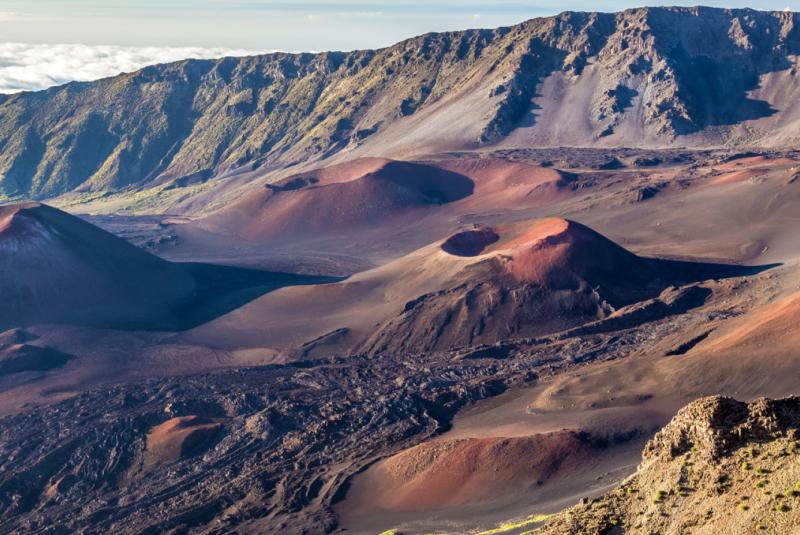
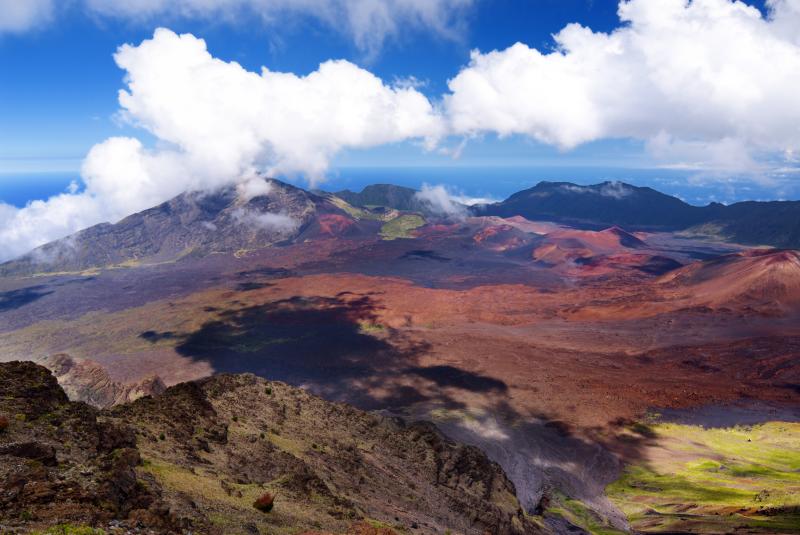
You're at Leleiwi Overlook, 8,800 feet. The bowl below you is the "crater," though it's not a true volcanic crater — Haleakalā's summit depression was carved by erosion, then partially filled by later eruptions. The result is a 7-mile-long, 2-mile-wide bowl with cinder cones rising from the floor and a back wall that drops 2,500 feet. The cinder cones down there — the red, orange, and yellow mounds dotting the floor — were built by eruptions that happened roughly 800 to 1,500 years ago, recent in geological terms. The Hawaiian name for the mountain, Haleakalā, means "house of the sun" — the legend goes that the demigod Māui lassoed the sun from this summit to slow its passage across the sky and give his mother more daylight to dry her tapa cloth. The Brocken spectre I mentioned — keep an eye on the clouds banking up against the back wall. If the sun is behind you and the cloud level is right, your shadow falls on the cloud and a rainbow ring forms around your head. Lasts ten or fifteen seconds, then the cloud shifts. About four miles up the road, Kalahaku Overlook has the silverswords — that's the next stop. -
 10 min from previous stop · 4 mi378MILE22
Kalahaku Overlook ~9,300 ft. Silversword (ʻāhinahina) garden along a short paved walk. Plant lives 20-90 years, blooms once with a 6-foot stalk, then dies. ESA-protected — stay on the path.
Approach Cue (~12-15 sec)Show transcript
Kalahaku Overlook on the mauka side, about a quarter mile ahead. Pull in. Short paved walk. This is the silversword stop — the iconic Haleakalā plant, ʻāhinahina, only grows here and on Mauna Kea. Stay on the designated path. Their roots are right at the surface; one footprint kills the plant.Arrival Narration (~45-60 sec)Show transcript
You're at Kalahaku, 9,324 feet, looking at one of the most unusual plants on Earth. The Haleakalā silversword — ʻāhinahina, "the gray one" in Hawaiian — is endemic to this volcano, meaning it grows nowhere else on Earth. It evolved here over millions of years. The silver hairs on the leaves reflect ultraviolet radiation that's brutal at this elevation, and they trap a thin layer of warm air against the plant in freezing nights. Every silversword you can see lives 20 to 90 years before it bloom. Then one summer, when conditions are right, it sends up a flower stalk six to nine feet tall, covered in hundreds of purple-and-yellow flowers. After the bloom, the plant dies. That's its entire life cycle — decades of patient growing, one chance at reproduction, then dust. The species was almost extinct by the 1920s — feral goats had eaten most of them, and tourists were uprooting them as souvenirs. The fence around the population and the goat-eradication program in the 1980s saved it. The plant is federally protected under the Endangered Species Act. Walk the path, take pictures, don't touch. Five miles up the road, the visitor center sits at 9,740 feet — that's the sunrise spot if you're here pre-dawn. -
 12 min from previous stop · 5 mi378MILE27
Haleakalā Visitor Center, 9,740 ft. Crater overlook directly behind it. Sunrise viewing area — reservation required pre-7AM, $1/vehicle at recreation.gov.
Approach Cue (~12-15 sec)Show transcript
The Haleakalā Visitor Center coming up, 9,740 feet. Pull into the lot. The crater overlook is directly behind the building — short paved walk. If you're here for sunrise, this is the spot. Bathrooms inside the visitor center, a small bookstore and exhibit on the volcano, and rangers who can answer questions. The center opens around 6:30 AM, so for sunrise you're outside in the cold until then.Arrival Narration (~45-60 sec)Show transcript
You're at the Haleakalā Visitor Center, 9,740 feet, the sunrise viewing area. From the railing behind the building you're looking straight into the deepest part of the crater bowl. At dawn, the sun comes up over the back rim and lights the cinder cones from above — the red and orange colors deepen, the shadows shorten, and the whole bowl shifts from gray to copper to gold over about 20 minutes. Sunrise here requires advance reservation at recreation.gov for any arrival before 7 AM, costs $1 per vehicle, releases 60 days in advance, and books out within a few hours every day. Past 7 AM you don't need a reservation, but the magic light is already gone. The temperature at sunrise is usually 30 to 45 degrees Fahrenheit with wind — it really is that cold up here, and the wind chill is no joke. Bring a fleece, a windbreaker, gloves if you have them, long pants, closed shoes. The visitor center exhibit inside is small but worth five minutes — geology of the summit, photographs of past eruptions, a brief on the Hawaiian cultural significance of the site. Two miles up, the road ends at Puʻu ʻUlaʻula — the actual summit. -
6 min from previous stop · 2 mi378MILE29Stop · mile 29 mauka
Summit Puu Ulaula
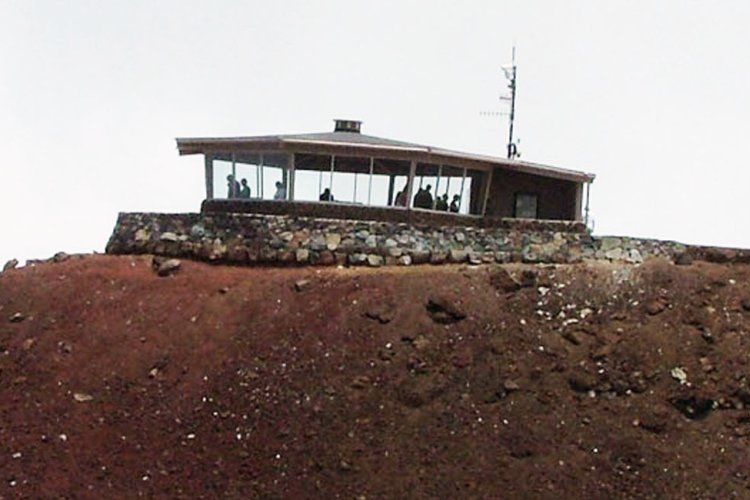
Puʻu ʻUlaʻula, the true summit. 10,023 ft. Glass-walled summit shelter. Astronomical observatory complex (Haleakala High Altitude Observatory) on the adjacent peak — closed to the public.
Approach Cue (~12-15 sec)Show transcript
Puʻu ʻUlaʻula coming up — the true summit, 10,023 feet. The road dead-ends at the parking lot. Short walk up to the glass-walled summit shelter. Across the saddle to the south, you'll see the white domes of the Haleakalā High Altitude Observatory complex — those are research observatories, closed to the public, but a striking visual. On clear days from up here you can see the Big Island's Mauna Kea and Mauna Loa across the channel.Arrival Narration (~45-60 sec)Show transcript
You're at the top of Haleakalā, Puʻu ʻUlaʻula, 10,023 feet. This is the highest point on Maui and one of the highest paved-road summits in the United States. The shelter is glass-walled — go inside, it's much warmer out of the wind. From the south side of the summit, look across the saddle to the cluster of white domes — that's the Haleakalā High Altitude Observatory. The Air Force runs one of those telescopes, the University of Hawaii runs others. The Pan-STARRS survey, which scans the sky for asteroids and comets that might hit Earth, runs from up here. The site is protected from most light pollution because the trade-wind cloud layer sits below it most nights, so the air above the summit is exceptionally clear and stable for astronomy. The observatories themselves are closed to the public, but the view of the domes against the sky is part of the summit experience. On a clear morning you can see across the ʻAlenuihāhā Channel to the Big Island — Mauna Kea and Mauna Loa, both nearly 14,000 feet, will be visible to the south. From here, the only way down is the way you came. Plan two hours to retrace the route to Pukalani. And take it easy on the brakes — riding the brake pedal down 36 miles of switchback will overheat them. Use a low gear and let the engine slow you on the steeper sections. -
Outro
Outro
Show transcript
That's the drive. From the upcountry junction at Pukalani, past the Hosmer Grove forest, the first crater view at Leleiwi, the silversword garden at Kalahaku, the sunrise overlook at the visitor center, and finally the true summit at Puʻu ʻUlaʻula. Two hours back to Pukalani if you don't stop, more if you pull off again. Use a low gear, not the brake pedal, on the descent — long stretches of brake-riding overheat brake pads and the failure mode at 8,000 feet is bad. Once you're back to Pukalani, the upcountry strip is right there: lunch at Komoda Store Bakery in Makawao for the cream puffs (cash only, get there before they sell out), Kula Lodge for a sit-down meal with a view, MauiWine in Ulupalakua for a tasting if you have an extra hour. Tomorrow — if you've got the energy — the Hāna Highway is the other Maui must-drive. Different direction, completely different mountain.
AI-narrated audio synthesized by ElevenLabs, voiced by Hoku (feminine) and Honu (masculine). Hoku and Honu are Voice Library donors, not native Hawaiian speakers. Some pronunciations may land slightly off — mahalo for your patience as we refine.

Try out our AI Powered
Search & Chatbot →

Get Your Free Hawaii Visitor Guide
Enter your email and we'll send you instant access to our free 2026 Hawaii Starter Guide + Summary Guidesheets.