Hawaiʻi Guide · Audio Driving Tour
Waimea Canyon Drive BETA
A 19-mile climb up Hawaii Route 550 from Waimea Town on the south coast to the Puʻu o Kila Lookout above the Kalalau Valley — the "Grand Canyon of the Pacific" overlook, Kokeʻe State Park, and the rim above Na Pali. ~7 curated segments. Free AI-narrated audio companion.
19 miles
37 min driving
6 curated stops
Free AI-narrated tour
37 min
driving time
19 mi
total distance
6 stops
curated stops
~3h
suggested day
We may link to trusted Hawaiʻi resources at no extra cost to you.
Route Map
6 stops
·
active stop
Loading map…
Build your own route
Pick a preset or tap the ✓ Include chip on any stop below to customize.
6
of 6 stops selected
-
Intro
Intro
Show transcript
The drive up Waimea Canyon is 19 miles, all climb, from sea level in Waimea Town to 4,000 feet at Puʻu o Kila — the lookout where the paved road ends and the rim of the Kalalau Valley drops 2,000 feet to the floor below. Plan two to three hours one way if you stop at the main lookouts, more if you stop for hikes. There's no gas station above Waimea Town. Fill the tank before you start, bring water and snacks, bring a fleece — the air at the top is 15 to 20 degrees cooler than the coast, and Kalalau Lookout is socked in by clouds half the time. Two practical notes. State park entry fees apply: $5 per non-resident person and $10 per non-resident vehicle, and one fee covers both Waimea Canyon State Park and Kokeʻe State Park — pay once. Hawaii residents enter free with ID. Second — the road is paved the entire way, but it's narrow and curvy. Don't rush it. The guide will announce each lookout as it comes up. -
550MILE0Stop · mile 0 makai
Waimea Town
Waimea Town is the gateway. Last gas, restrooms, restaurants. The turn-off for Hwy 550 (Waimea Canyon Drive) is on the mauka side from Hwy 50.
Approach Cue (~12-15 sec)Show transcript
Waimea Town coming up — the start of the drive. Last gas before the canyon. The Chevron and Shell stations both sit on Hwy 50 (Kaumualii Highway). Top off here. The turn-off for Hwy 550 — Waimea Canyon Drive — is at the stoplight in the middle of town, mauka side.Arrival Narration (~45-60 sec)Show transcript
Waimea is one of the oldest towns on Kauai. Captain Cook landed here in January 1778 — the first European to set foot in the Hawaiian Islands — and the bay just south of town is where it happened. There's a bronze statue of him in town if you want to see it. The town itself is small: a stoplight, a couple of restaurants, two gas stations, a couple of shave-ice spots. Jo-Jo's Shave Ice is the local pick — they've been in business since the 1980s and they make their own syrups from real fruit. Pacific Pizza, on the south side of the highway, is the lunch spot if you're hungry. Top off the gas tank — the next station is back here in Waimea on your way down, and there's nothing in the canyon. Now turn mauka onto Hwy 550 and start the climb. The first canyon lookout is about eight miles up. -
Connector · 550 18 min drive · 10 mi
Canyon Climb Connector
Show transcript
You're climbing now. The road switchbacks up through dry forest — kiawe, koa, the occasional silver oak — and on a clear day you'll catch glimpses of the canyon to your right and the ocean opening up behind you. The first few miles are gentle but the grade picks up after mile three and the switchbacks tighten. You'll pass two minor pull-offs that locals use for bird hunting access — keep going. The first real lookout, the Waimea Canyon Lookout, is at mile 10 — that's the iconic one, the postcard view. About a mile before you reach it, the canyon really starts to open up on your right and you'll see why the road exists. Keep an eye on your speed on the curves and watch for slow trucks ahead — passing zones are limited. -
18 min from previous stop · 10 mi550MILE10
The headline lookout. ~10 miles up. Paid parking lot, restrooms, viewing platform. The "Grand Canyon of the Pacific" framing is widespread but the famous Mark Twain attribution is apocryphal — Twain never visited Waimea Canyon. Don't repeat the quote as fact.
Approach Cue (~12-15 sec)Show transcript
Waimea Canyon Lookout coming up on the right — the main canyon overlook. Pull into the lot. State park fees apply: $5 per non-resident person, $10 per non-resident vehicle, residents free with ID. One fee covers both Waimea Canyon and Kokeʻe State Parks for the day, so pay once. Restrooms and a paved walkway to the railing.Arrival Narration (~45-60 sec)Show transcript
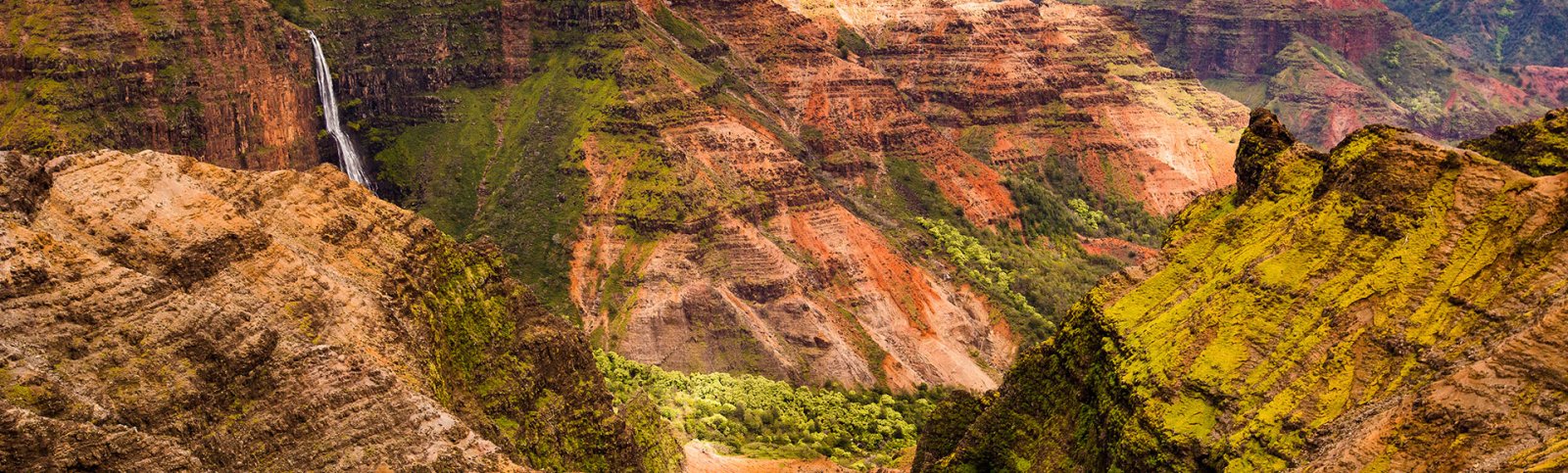
You're at the Waimea Canyon Lookout. The canyon below you is roughly 14 miles long, a mile wide, and 3,600 feet deep. It's been carved over the last four million years by the Waimea River cutting through the lava flows that built the western half of the island. The red and orange you see in the canyon walls is iron oxide — old lava that's been weathering for millions of years. The greens are vegetation that's grown in the cracks and on the wider ledges. On a clear morning you can see all the way to the ocean from here. Often, by mid-afternoon, clouds roll in from the windward side and the canyon fills with mist that drains slowly down the gorge — that's worth watching too. About the "Grand Canyon of the Pacific" line — you'll see it on every t-shirt, in every guidebook, and it's commonly attributed to Mark Twain. Twain never came to Kauai. He never saw this canyon. The phrase has been around since the early 1900s but no one knows who actually said it first. The view does the work regardless. Plan ten or fifteen minutes here. Puʻu Hinahina Lookout is about three miles ahead. -
6 min from previous stop · 3 mi550MILE13Stop · mile 13 mauka
Puu Hinahina Lookout
Two viewing platforms. The east platform looks down a side gorge of the canyon. The west platform looks toward Niʻihau, the Forbidden Isle, on a clear day.
Approach Cue (~12-15 sec)Show transcript
Puʻu Hinahina Lookout coming up on the right. Two short walks from the parking lot — one platform looks back into the canyon, the other looks west toward the open ocean and Niʻihau. If the weather is clear, take the west platform.Arrival Narration (~45-60 sec)Show transcript
Puʻu Hinahina sits at about 3,640 feet, and on a clear day from the west platform you can see Niʻihau — the Forbidden Isle — sitting 17 miles off the southwestern coast of Kauai. Niʻihau has been privately owned by the Robinson family since 1864 and is closed to outside visitors. The roughly 170 native Hawaiians who live there speak Hawaiian as their first language, no electricity grid, no paved roads, and the only way in for outsiders is by invitation or by hunting safari run by the family. The east platform looks back into a side branch of Waimea Canyon — a smaller, tighter view of the same red-rock walls you saw at the main lookout. Worth a quick stop for both views. The Kokeʻe State Park entrance and visitor center is about two miles ahead. -
4 min from previous stop · 2 mi550MILE15
Kokeʻe State Park HQ. Free Natural History Museum, Lodge restaurant, trailheads for the Cliff/Canyon trails, Pihea, Awaʻawapuhi.
Approach Cue (~12-15 sec)Show transcript
Kokeʻe State Park coming up on the right. The main meadow, the Kokeʻe Natural History Museum, and the Lodge restaurant are all on the makai side. The museum is free, small, and worth a 15-minute stop — local ecology, weather forecasts for the trails posted at the door, and the best place to ask a ranger about current trail conditions before you hike anything.Arrival Narration (~45-60 sec)Show transcript
You're at the heart of Kokeʻe State Park, at about 3,600 feet elevation — the highest accessible point on Kauai by paved road. The meadow on your left is where the chickens you've been seeing for the last three days came from — Kauai is overrun with feral chickens descended from Polynesian junglefowl, and Kokeʻe is the densest population on the island. The Kokeʻe Natural History Museum is small but excellent: free admission, weather forecast posted by the door (critical for hiking), good explanations of the unique ecosystems up here, and a friendly docent who'll tell you which trails are doable in current conditions. The Lodge restaurant next door does breakfast and lunch — pancakes, hot soup, sandwiches, hot coffee — and on a cold morning at 4,000 feet it's exactly what you want. Trailheads for Awaʻawapuhi, Pihea, and the Cliff and Canyon trails are nearby. If you have a half day extra, the Awaʻawapuhi Trail (3.25 miles each way, 1,600 feet of descent and climb-back) ends at one of the most dramatic viewpoints on the island — a cliff edge looking straight down into a hanging valley above the Na Pali coast. Don't take it lightly. Kalalau Lookout is about three miles ahead. -
6 min from previous stop · 3 mi550MILE18
The Kalalau Valley overlook. Easier access than Puʻu o Kila one mile farther up. Often clouded in by 1pm. Best in early morning.
Approach Cue (~12-15 sec)Show transcript
Kalalau Lookout coming up on the right — this is the postcard. The lookout sits at 4,000 feet on the rim of the Kalalau Valley and looks straight down 2,000 feet to the valley floor and out to the ocean. Mornings are the best time — clouds usually roll in by early afternoon and bury the view. If the lookout is socked in when you arrive, give it ten minutes; the cloud bank often shifts.Arrival Narration (~45-60 sec)Show transcript
Kalalau Lookout is the view. You're at 4,000 feet on the rim of the Kalalau Valley, looking down 2,000 feet to a green hanging valley cradled between sheer cliffs that drop another 1,000 feet to the Pacific. The valley itself was inhabited by Hawaiians for over 800 years — taro lo'i (irrigated taro patches), house sites, heiau (sacred structures) — and the last permanent residents left in 1919. Today the valley is part of the Na Pali Coast State Wilderness Park, accessible only by hiking 11 miles in on the Kalalau Trail or by kayak from the north shore. From up here you can sometimes see hikers on the cliffs below as moving specks, and on rare clear days you can see the switchbacks of the Kalalau Trail itself. Clouds matter here. The windward side of Kauai pushes warm wet air up and over the rim of the valley, and that air condenses into the cloud bank that sits on the lookout most afternoons. If your view is white, give it ten minutes — the bank shifts, and you'll often get a 30-second window where the clouds part and the entire valley opens up below you. Puʻu o Kila, one more mile up the road, is the final lookout — slightly different view angle, end of the paved road. -
3 min from previous stop · 1 mi550MILE19Stop · mile 19 makai
Puu O Kila Lookout
The end of paved Hwy 550. Higher elevation than Kalalau Lookout, slightly different viewing angle into Kalalau Valley. Trailhead for the Pihea Trail.
Approach Cue (~12-15 sec)Show transcript
Puʻu o Kila coming up — the end of the paved road. The road keeps going as a rough dirt track from here but you don't drive it; rental cars are not allowed past the paved section. The lookout itself is a slightly different angle into Kalalau Valley than the main Kalalau Lookout you just stopped at, and it's the trailhead for the Pihea Trail.Arrival Narration (~45-60 sec)Show transcript
You're at Puʻu o Kila, 4,176 feet, the end of the paved road and the farthest point you can drive on Kauai. The lookout angle into Kalalau Valley is slightly different from the main Kalalau Lookout — you're a hundred feet higher and looking from a slightly different bearing — and on the right day, when the clouds part, this is the better view. The dirt track that continues past the gate is the unmaintained extension of Hwy 550; rental cars are prohibited and the road becomes a 4WD track within a quarter mile. The trailhead for the Pihea Trail starts here — a 4-mile out-and-back along the rim of the valley to the Pihea Vista, with views down into Kalalau the whole way. The trail is muddy and rooty year-round, even in dry weather, so wear shoes you don't mind ruining. From here, you turn around. There's no other way back. -
Outro
Outro
Show transcript
That's the drive. From Waimea Town at sea level, past the main canyon lookout, Puʻu Hinahina, Kokeʻe State Park, Kalalau, and now Puʻu o Kila at the end of the road. Plan an hour to get back down to Waimea — the drive down feels shorter because you already know the curves, but pace yourself and use the engine to brake on the steeper sections rather than riding the brake pedal. Once you're back at sea level, two ways to spend the rest of the day. East — Hwy 50 takes you back through Hanapepe, Old Koloa Town, and Poʻipū beaches. West — Hwy 50 dead-ends at the unmarked turnoff for Polihale State Park, the longest beach on the island, accessible only by a rough 5-mile dirt road through the old cane fields. Polihale is worth it if you have a 4WD and time, but the road is rough. Tomorrow, check the North Shore drive to Hanalei and Kēʻē Beach — same dramatic Na Pali rim, completely different angle.
AI-narrated audio synthesized by ElevenLabs, voiced by Hoku (feminine) and Honu (masculine). Hoku and Honu are Voice Library donors, not native Hawaiian speakers. Some pronunciations may land slightly off — mahalo for your patience as we refine.

Try out our AI Powered
Search & Chatbot →

Get Your Free Hawaii Visitor Guide
Enter your email and we'll send you instant access to our free 2026 Hawaii Starter Guide + Summary Guidesheets.