Explore Maui by Region
Maui has been a favorite tourist destination for decades because it represents the quintessential tropical getaway. With its beautiful coastal views, eclectic volcanoes, wildlife sanctuaries nearby, and a wide majority of the island left wild and free from rampant development, there are countless things to do in Maui that will leave you authentically charmed!
Maui comprises two major volcanic areas, the older and extinct West Maui Mountains and a very expansive volcano named Haleakala on the eastern side of the island. In between the two is a valley filled with deposits. The center of the island is where Maui earns its nickname, the "Valley Isle." The isthmus stretching from Haleakala to the West Maui mountains is likely where you'll begin your journey- at the Kahului airport. No region is quite like another on the Valley Isle.
Maui has a lot going for it, especially for such a small island. It combines some of the best food, shopping, and entertainment choices from several of the other Hawaiian islands while emphasizing outdoor fun rather than late-night party scene, like Oahu, which makes plenty of regular visitors happy. The island has several small towns, especially along the coast, giving much of the island a small but not rural vibe. Maui is not as large or varied in terrain as the Big Island or as weathered and verdant as Kauai. Still, its 10,000+ foot volcano Haleakala, combined with the incredible coastline views along the Road to Hana, and unique places like the 'Iao Valley and Wai'anapanapa Black Sand Beach make Maui a unique and special place to visit all on its own
— article continued below —
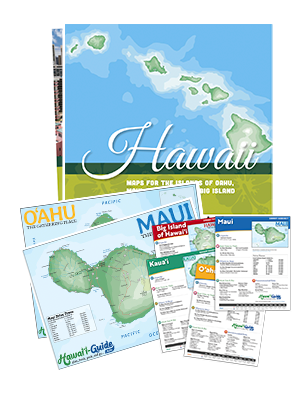
2024 Maui Visitor Guides
Visiting Maui soon? Be sure to grab your copy of one of our updated Maui Visitor Guides.
~ Trusted by Millions of Hawaii Visitors Annually ~

There is much debate about how to split up an island like Maui by region so we can describe it on a website such as this. Why the controversy you ask? Well, Maui, like all the Hawaiian islands, is part of a county politically divided into several districts, clockwise: Lahaina, Wailuku, Makawao, and Hana. Since Molokai and Lanai are also technically inside Maui county, they are also districts, but we're ignoring them here. Quite honestly, to the modern-day traveler, these districts serve no purpose.
The remedy then is to find a way to divide the island into segments that are easy to recognize, describe, and access via the major roads of the island. This is where much of the debate comes from. Every "expert" has their own way of dissecting the island into pieces.
Our way is pretty simple, and the method we've followed online mirrors the format we've utilized in our physical guidebooks and eBooks too. Ultimately we've divided the island in a manner that helps us group attractions together so that they are easily accessible along the major routes of the island. This allows us to use our mile-by-mile directions to quickly and accurately describe each spot here on our website.
Lahaina & Ka'anapali Region Guide
The resort areas of Ka'anapali, famous for the three-mile-long Ka'anapali Beach and historic Lahaina Town, grace the shores of western-most Maui. While both are technically inside our West Maui region, we've dedicated a unique section for each major attraction in these two popular areas.
With plenty of sunshine and great weather year-round, this stretch of Maui coastline has become the playground of visitors from around the world and is a popular location for taking a snorkel cruise, doing some window shopping, or catching one of the very best Hula shows in all of Hawaii.
Unfortunately, catastrophic wildfires have destroyed much of Lahaina town on Maui as of August 2023. This includes devastation along Front Street and much of the surrounding areas. More information will be provided in a future update.
Hana Highway Region Guide
Hana Highway (northeast and parts of southeast Maui), ranges from Pa'ia town to the community of Hana (Haa-na) on the northeastern tip of the island and is renowned for great wind surfing, lush rural scenery, and, of course, the famous Road To Hana (Hana Hwy - 360) drive that curves along the coastline toward Hana town.
Known often as the windward side, it is largely undeveloped and much of the narrow Hana Highway winds along the island's beautiful northern coastline.
Kihei & Wailea Region Guide
South Maui is best known for its miles of white sandy beaches, spectacular coastal areas, snorkeling on its reefs, and expansive lava fields like La Perouse Bay.
Sheltered on the leeward side of Haleakala volcano, this side of Maui is quite drier and sunnier than the rest of the island.
Today, South Maui includes the coastal communities of Ma'alaea and Kihei and the growing resort communities of Wailea and Makena. There's also a good deal of Wailea real estate and Wailea condos available on this part of Maui.
Upcountry Maui & Haleakala Region Guide
The term Upcountry Maui refers to the towns, ranches, vineyards, parks, farmlands, and visitor attractions on the upper slopes of Haleakala volcano, including Haleakala National Park. Enchanting and rural, Maui's Upcountry is the heart of the island's agricultural industry, as well as a thriving artists' community.
Many compare the beautiful landscape of Upcountry Maui to the countryside in Scotland. You'll also be sure to discover several unique floral gardens in this part of Maui. Plus, some of the best views of the South Pacific anywhere on the island can be found from the high elevations of the upcountry.
West Maui Region Guide
With plenty of sunshine and an abundance of rainfall (as much as 390 inches a year), West Maui was once a major Hawaiian population center and the proverbial playground of royalty (the ali'i) in old Hawaii. Today, west Maui has become the playground of visitors from around the world.
Along the shores of West Maui you'll find the resort area of Kapalua (northwest), Kahana and Honokowai (mid-way), visitor community of Napili, and while technically located within west Maui, our Lahaina and Kaanapali region (both in the southwest of this region as noted previously) has been devoted a section unto itself.
Ultimately, west Maui is one of the more developed portions of the island, with several resorts and small towns. The most north-western portion of this region is almost completely undeveloped and is raw and somewhat barren terrain.
Central Maui Region Guide
The proverbial 'heart' of Maui, Central Maui, is the isthmus that connects Maui's two volcanoes. Your visit to Maui likely began here at the airport in Kahului.
Today, Central Maui includes residential communities, sugar and pineapple plantations, county and state government offices, and various visitor attractions including the Kahului Airport (OGG), the Maui Tropical Plantation, golf courses, parks, shopping areas, and more.
We've also included the 'Iao Valley State Park in this area since it's accessible only through Central Maui.